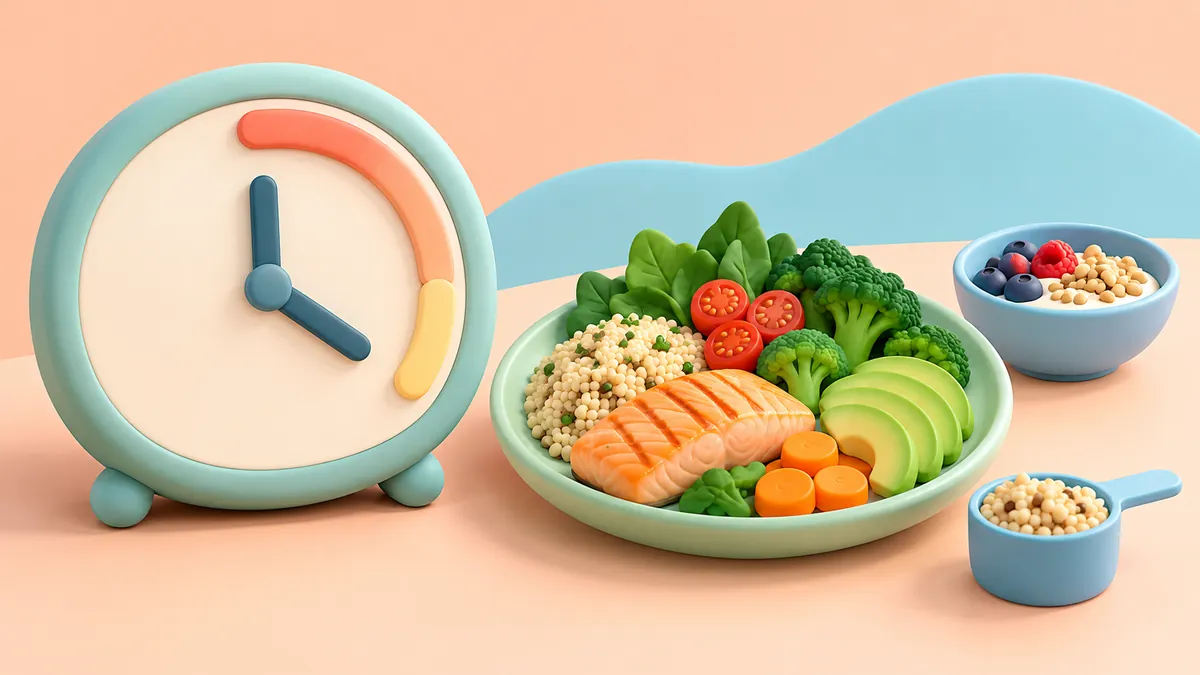
Intermittent fasting (IF) is a schedule, not a diet. It tells you when to eat, not what or how much. That distinction is the source of most confusion: people pick a fasting window, skip breakfast, and assume the scale will take care of itself. It usually doesn't. Fasting helps when it makes hitting a calorie target easier — and stops helping when it doesn't.
Quick Answer
- IF works for fat loss the same way every diet works: by creating a calorie deficit.
- The most popular protocol is 16:8 — 16 hours fasting, 8 hours eating.
- Track total daily calories with our Calorie Calculator. The fasting schedule sits around the calorie target, not instead of it.
- IF is not magic; it is a useful behaviour tool for people who naturally eat less in a shorter window.
What Counts as "Intermittent Fasting"
Most plans fall into a few simple shapes:
- 16:8 — 8-hour eating window (e.g., 12 pm to 8 pm). The most common starting point.
- 18:6 / 20:4 — narrower windows, often called "warrior" style.
- 5:2 — five normal-eating days, two days at ~500–600 kcal.
- OMAD — One Meal A Day. Strict 23:1.
- Alternate-day fasting — one fed day, one very-low-calorie day.
The variable is eating window. The constant — always — is weekly calorie totals.
Why IF Helps Some People Lose Weight
There is no special metabolic trick. The advantages are behavioural:
- Fewer eating occasions → fewer chances to over-eat by drift.
- Coffee/tea/water-only mornings push back the first calorie input → easier overall control.
- A defined start time for eating helps people who graze without thinking.
It can also fit modern life: skipping breakfast is socially low-cost, while skipping dinner with family is not.
When IF Doesn't Help
IF backfires when:
- You over-eat at the open of the window to "make up" for fasting — net calories end up the same or higher.
- You train hard early in the morning and need fuel before workouts.
- You have a history of disordered eating — restrictive windows can intensify patterns.
- You are under high stress / poor sleep; long fasts on top can elevate cortisol and mood swings.
If any of those apply, a simpler "eat to your calorie target across three meals" plan works better.
Protocols Compared
Picking the right window is mostly about lifestyle, not biology:
| Protocol | Fasting / Eating | Typical adherence | Best fit | |---|---|---|---| | 12:12 | Skip late-night snacks | Easiest | Anyone with grazing habits | | 14:10 | Late breakfast | High | First-time fasters, active women | | 16:8 | Skip breakfast | High-medium | Most beginners after 2-week ramp | | 18:6 | Late lunch, early dinner | Medium | Office workers, low-training days | | 20:4 | Two close meals | Low-medium | Short-term cut blocks | | OMAD (23:1) | One meal | Low | Maintenance veterans, not beginners | | 5:2 | 5 normal + 2 very-low days | Medium | People who hate daily windows |
The honest pattern: start one step wider than you think you can handle, then narrow if needed. People who jump to OMAD in week one almost always over-eat at the open and end the experiment within a month.
What the Research Actually Shows
The headline finding from controlled trials — including the much-cited Harvard / NIH meta-analyses through 2023–2024 — is consistent:
- Weight loss is similar to ordinary calorie restriction when total calories are matched. The "fasting bonus" disappears in controlled studies.
- Insulin sensitivity improves modestly on IF, but most of that effect is downstream of fat loss rather than the fasting schedule per se.
- Blood pressure and triglycerides improve on most IF protocols, again largely tracking fat loss.
- Lean mass retention is comparable to other diets when protein is adequate (≥1.6 g/kg) and resistance training is part of the plan.
- The Ramadan literature — the largest natural dataset of IF in humans — shows no metabolic harm and modest body composition improvements when calories drop.
Where IF does outperform: adherence in real life over 6–12 months, for people whose schedules suit it. That practical advantage matters more than the lab differences.
Combining IF With a Calorie Target
The honest workflow is exactly the same as any other plan:
- Compute calories with our TDEE Calculator and Calorie Calculator.
- Set protein (1.6–2.2 g/kg) with our Macro Calculator.
- Pick a fasting window that fits your life and naturally fits your calorie target.
- Eat that target inside the window.
A common setup for a 70 kg adult cutting at 2,000 kcal:
- 16:8 window: noon → 8 pm
- Meals: 12:30 lunch (700 kcal), 4:30 snack (300 kcal), 7:30 dinner (1,000 kcal)
- Protein anchored at 140 g across the three eating occasions
Common Misconceptions
- "Fasted cardio burns more fat." Acute fuel use changes, but 24-hour fat loss is the same when calories match.
- "Black coffee breaks the fast." Practically no — black coffee, tea and water are fine in the fasting window.
- "Autophagy kicks in at exactly 16 hours." Autophagy is ongoing and harder to measure in humans than headlines suggest. It is a bonus, not a primary mechanism for weight loss.
- "IF lets me eat anything in the window." Quality and quantity still matter. A 16:8 window full of pastries and pizza will not produce fat loss.
Hunger Management
The first 1–2 weeks are usually the hardest. Some honest tools:
- Stay hydrated — thirst masquerades as hunger.
- Caffeine in moderation — blunts appetite for many.
- Salt — light pinch in water during the fast helps adherence for some.
- Protein-heavy break-fast meal — slows the next hunger wave.
- Don't pair the fast with sleep cuts — under-recovery amplifies hunger signals.
If hunger spikes are extreme by week three, shorten the fast (16:8 → 14:10) rather than push through.
Training in a Fasted Window
For endurance work (Zone 1–2), most people can train fasted without issues. For strength training and high-intensity intervals, performance often drops if the last meal was 12+ hours earlier. Practical patterns:
- Train early, then break fast — coffee, hydrate, lift, then first meal within an hour after.
- Slide the window — start eating at 10 am if your gym time is 9 am; close at 6 pm.
- Use whey + carbs intra-workout — strictly this breaks the fast, but the muscle-building math is straightforward and many people use it.
The aim is fatigue management, not "purity" of the fast.
A Worked Example
A 32-year-old, 78 kg woman, moderately active. TDEE ≈ 2,200 kcal. Cutting at −500.
- Target: 1,700 kcal/day
- Protein: 78 × 2.0 = 155 g (~620 kcal)
- Fat: 78 × 0.7 = 55 g (~495 kcal)
- Carbs: (1,700 − 620 − 495) / 4 ≈ 146 g
Window 12 pm–8 pm:
- 12:30 lunch — Greek yoghurt (200 g) + fruit + granola
- 3:30 snack — chicken wrap + apple
- 7:30 dinner — salmon, potato, mixed vegetables, side salad
Hit the macros, hit the window, sleep well. The plan works.
Special Situations
A few real-life patterns where the default 16:8 needs adjusting:
- Shift workers and overnight schedules — anchor the window to your own sleep–wake cycle, not the clock. A nurse working 9 pm–7 am might run an eating window of 4 pm–midnight; the math is identical.
- Frequent travel across time zones — pause the protocol on travel days and resume on the new local time. Forcing a window through jet lag erodes sleep, which costs more than the fast saves.
- Endurance training blocks — extend the eating window on high-volume days (e.g., long-run Saturdays). Trying to refuel a 25 km run inside a 6-hour window will sabotage the next session.
- Hormonal cycles — many women find the luteal phase (days 14–28) increases hunger and need for carbs. Loosening to 12:12 for that week, then returning to 16:8, often improves adherence over the month.
- Diabetes (type 2, well-controlled) — IF can improve markers, but only with physician oversight. Hypoglycaemia risk on metformin/insulin makes self-experimentation unsafe.
The general rule: the schedule serves the human, not the reverse. If the protocol fights your life, change the protocol.
Common Mistakes
- Picking the smallest window first. Start with 14:10 or 16:8, not OMAD. Adherence over months matters more than the spec.
- Skipping protein to maximise fast length. Inadequate protein costs muscle no matter the schedule.
- Using IF instead of calorie tracking. The two work together; one without the other often stalls.
- Calling it "fasting" if you drink calorie-laden coffee drinks. Lattes and bulletproof coffees with butter are not fasting — they are meals.
Frequently Asked Questions
Is IF better than three-meals-a-day for fat loss?
Not inherently. When calories and protein are matched, fat loss is about the same. The win for IF is adherence for people who eat less naturally in a smaller window.
Will IF mess with my metabolism?
Short-term fasting (12–24 hours) does not lower metabolic rate meaningfully. Prolonged severe restriction (multiple days, very-low-calorie) can. The 16:8 routine is far from that line.
Can women do IF?
Yes, with caveats. Hormonal sensitivity is real; many women feel best on shorter fasts (12–14 hours) and find longer ones disruptive. Athletes during heavy training may also prefer shorter fasts.
Does coffee break the fast?
Black, no calories — practically no. Anything with milk, sugar, syrups or "creamer" does. MCT oil and butter add calories and end the fast for nutritional purposes.
Should I take supplements during the fast?
Most vitamins are fine. Fat-soluble vitamins (A, D, E, K) absorb better with food, so save those for the eating window. Caffeine and electrolytes are fine in the fast.
How long until I see results?
Expect 2–3 weeks before fat-loss trends emerge on the scale (water-weight noise dominates earlier). Hunger usually normalises around the same point. If nothing has moved after 4 weeks, the issue is almost always calorie tracking — not the protocol itself.
Can I combine IF with keto or low-carb?
Yes, and the combination is popular because both reduce eating occasions. The downside is stacked restrictions: window + carb cap + calorie target can be too much for adherence. Try one variable at a time for at least a month before layering.
What's the safe upper limit for daily fasting?
For most healthy adults under medical supervision, 24-hour fasts once a week are well-tolerated. Beyond 48 hours, electrolyte loss and lean-mass cost climb sharply, and the diminishing return rarely justifies the discomfort. The point of IF is repeatable lifestyle restriction, not endurance feats.
Bottom Line
Intermittent fasting is a useful schedule tool for people whose natural eating pattern fits a narrower window. It does not replace the calorie math:
- Compute the target calories with our Calorie Calculator.
- Pick a fasting protocol you can sustain (start at 14:10 or 16:8).
- Hit your protein and total calories inside the window.
- Re-check the trend over 2–3 weeks and adjust by 10% if reality disagrees with the prediction.
If fasting makes your math easier, it's the right tool. If it makes you over-eat at the open, it isn't.
Health and fitness calculations are estimates only and not medical advice. Anyone with diabetes, gallstones, a history of disordered eating, who is pregnant, nursing, or has a chronic condition should talk to a healthcare professional before starting IF.