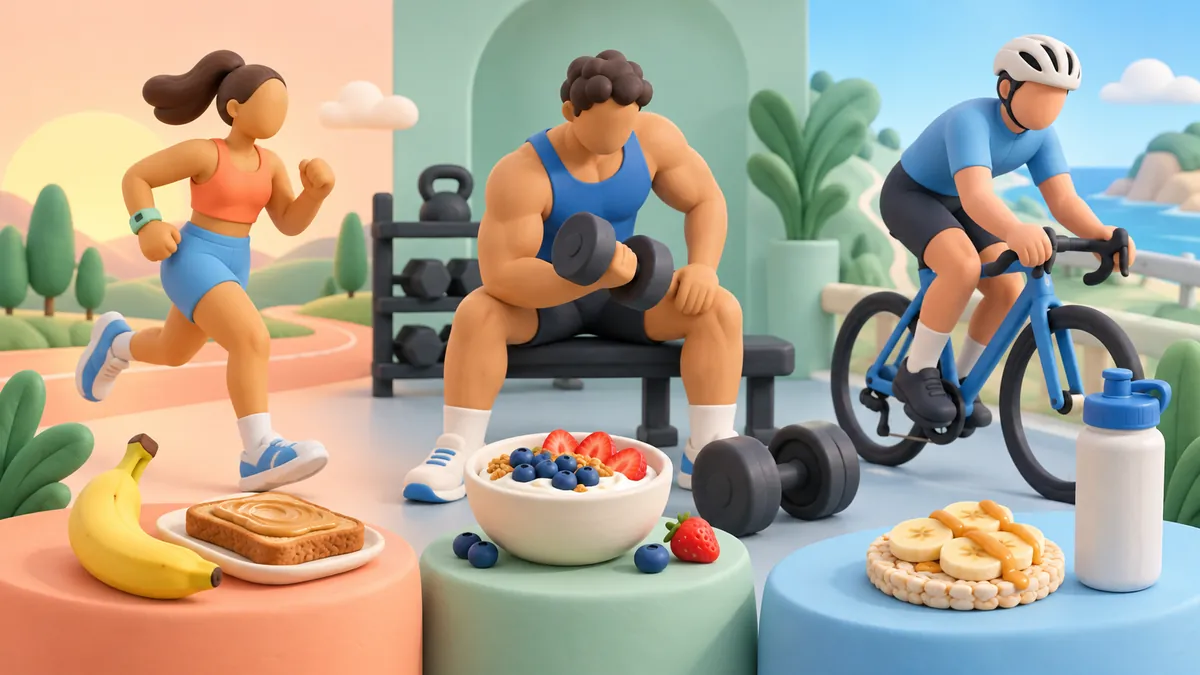
What you eat before a workout should change based on what you are about to do. A 5x5 squat session, a 90-minute long run and a 20-minute HIIT class all stress the body differently — and the generic "pre-workout meal" advice treats them as the same problem. They are not. This guide gives you a modality-specific prescription: carbs, protein, fat, timing and caffeine, with realistic options for the 3-hours-out, 1-hour-out and 15-minutes-out windows.
Quick Answer
| Modality | Carbs (per kg) | Protein (per kg) | Fat | Timing target | |---|---|---|---|---| | Strength / hypertrophy | 0.5–1.0 g | 0.3–0.4 g | low to moderate | 1–2 hours pre | | Endurance (60+ min) | 1.0–2.0 g | 0.2 g | low | 2–3 hours pre | | HIIT / mixed | 0.5–1.0 g | 0.2–0.3 g | low | 60–90 min pre | | Fasted easy cardio | 0 (optional 20–30 g) | optional | low | n/a |
- Default rule: the longer and harder the session, the more carbs and the earlier the meal.
- Protein is universal — 20 to 40 g in the 1 to 3 hours before lifting helps, but timing matters less than your daily total.
- Caffeine works best at 3 to 6 mg per kg taken 30 to 60 minutes pre.
- Plan session macro splits in the Macro Calculator and check overall needs via the Calorie Calculator.
Why Pre-Workout Nutrition Matters by Modality
The body uses different fuel mixes at different intensities. Below your first lactate threshold, fat oxidation handles most of the work and the pre-workout meal does very little. Above that, carbohydrate becomes the dominant substrate.
Three things change the prescription:
- Duration — sessions longer than about 60 minutes deplete glycogen enough that pre-fueling improves the back half.
- Intensity — high-glycolytic work draws on glycogen at multiples of the zone-2 rate.
- Total daily volume — a single moderate session barely needs special fueling. Two-a-days and long sessions do.
Strength is intermittent and short, so the meal can be modest. Endurance is long and continuous, so the meal has to fuel a clock. HIIT looks short but burns through glycogen fast. Mixed sessions compound the demand.
Strength and Hypertrophy: The Carbs-Plus-Protein Window
For a typical 45 to 75 minute strength session — 3 to 6 main lifts plus accessories — the prescription is straightforward.
Targets:
- Carbs: 0.5 to 1.0 g per kg of bodyweight. For an 80 kg lifter that's 40 to 80 g.
- Protein: 0.3 to 0.4 g per kg. About 25 to 35 g for an 80 kg lifter.
- Fat: keep low to moderate. Fat slows gastric emptying, which is fine 2 to 3 hours out but uncomfortable 60 minutes out.
- Timing: finish the meal 60 to 120 minutes before the warm-up.
A realistic meal at 90 minutes pre is a chicken wrap with rice and a banana. At 30 minutes pre, downsize: a scoop of whey with a banana, or Greek yogurt with honey. Both deliver the carb-plus-protein stimulus without sitting heavy on heavy sets.
Why this works. Carbs top up glycogen in the working muscles, which supports the higher-rep sets where most hypertrophy comes from. Protein 1 to 2 hours pre means amino acids are circulating during the session, which research suggests modestly improves the protein-synthesis response when you train near failure.
You can usually train pure strength (low reps, long rests) on minimal carbs because the ATP-PC system handles brief efforts. Hypertrophy style training is far more glycogen-dependent and benefits noticeably from the carb meal. For a 60 to 90 minute lifting block, the pre-workout meal is enough; intra-workout carbs are unnecessary unless you train for more than 90 minutes.
Endurance: Fueling 60+ Minute Sessions
This is where the pre-workout meal stops being optional and starts being part of the training plan.
Targets:
- Carbs: 1.0 to 2.0 g per kg, ramping up as the session gets longer. For a 70 kg runner: 70 to 140 g.
- Protein: 0.2 g per kg. About 15 g. Not the priority.
- Fat: as low as you can comfortably manage. Fat in the pre-race meal is the single most common cause of GI distress at minute 30 of a long run.
- Timing: 2 to 3 hours pre for the main meal, optional top-up 30 to 60 minutes out.
A standard pre-run breakfast: oatmeal with banana and honey, a slice of toast with jam, coffee. About 90 to 120 g of carbs, very low fat, modest protein, finished 2.5 hours before. For a shorter 60 to 75 minute session, half that meal is fine.
For sessions over 75 minutes, add 30 to 60 g of carbs per hour during the session — gels, drink mix, chews. The pre-workout meal sets the floor; intra-workout fueling does the bulk of the work beyond 90 minutes.
How many carbs before running specifically? Aim for 1 to 1.5 g per kg 2 to 3 hours out, then a small 20 to 30 g top-up 30 minutes before you start.
Use the Heart Rate Zone Calculator to confirm where your session intensity sits. Easy zone-2 work tolerates a lighter pre-meal; threshold and VO2 work needs the full carb load. Easy aerobic sessions under 60 minutes can usually be done on water and coffee — fat oxidation covers the demand. Once you cross 75 minutes, glycogen depletion starts to matter and the meal earns its place.
HIIT and Mixed Modality
HIIT classes look short — typically 20 to 40 minutes of work — but the intervals push glycolytic flux extremely high. A 25-minute HIIT session can deplete muscle glycogen by 30 to 40 percent.
Targets:
- Carbs: 0.5 to 1.0 g per kg, 60 to 90 minutes pre.
- Protein: 0.2 to 0.3 g per kg.
- Fat: low. You will regret a heavy fat meal in burpees.
- Timing: 60 to 90 minutes pre.
Mixed sessions — lifting plus 20 minutes of conditioning, or a CrossFit-style WOD — should be fueled like endurance sessions of the same total length. A 75-minute strength-and-conditioning block is closer to an endurance load than to pure strength.
A practical option: a small bowl of oatmeal with whey scooped in, 75 minutes pre. About 50 g carbs, 25 g protein, low fat. Easy to digest, supports both portions.
Timing: 3 Hours Out, 1 Hour Out, 15 Minutes Out
The same total nutrition delivered at different distances from the session feels very different. Here is how to scale by window.
3 hours out
A full mixed meal is fine. Rice, lean protein, vegetables, modest fat. Most people tolerate 60 to 100 g of carbs, 30 to 50 g of protein and 10 to 20 g of fat at this distance with no GI issues.
1 hour out
Cut the fat and fiber, keep carbs and protein. A bagel with jam and a small protein shake. Greek yogurt with honey and granola. About 40 to 60 g carbs, 20 g protein, minimal fat. Avoid large salads, cruciferous vegetables, or creamy dishes here.
15 to 30 minutes out
Liquid or near-liquid only. A banana, a sports drink, a gel, or whey in water. About 20 to 40 g of fast carbs and optional 10 to 20 g of protein. Solid food this close routes blood away from working muscle.
Pre-workout meal 2 hours before vs 30 minutes before
A 2-hour meal can be larger and more balanced. A 30-minute snack must be small, low-fat, low-fiber and mostly carbs. The test is GI comfort during the warm-up. If you finish your warm-up burping or weighted, you ate too much too close. If you feel light-headed and weak in the first 10 minutes, you ate too little or skipped the pre-meal entirely.
Caffeine and Pre-Workout Supplements (Briefly)
Caffeine is the most reliable ergogenic aid in sport nutrition.
- Dose: 3 to 6 mg per kg of bodyweight. For an 80 kg adult that's 240 to 480 mg — roughly 2 to 4 cups of coffee, or one moderate pre-workout scoop.
- Timing: 30 to 60 minutes before the session. Caffeine plasma levels peak around 45 minutes after ingestion.
- Modality bias: strongest evidence for endurance and high-intensity work. Strength benefits are real but smaller.
Avoid caffeine within 6 hours of bedtime if you train in the evening — the sleep cost can outweigh the session benefit. Habitual heavy coffee drinkers need to cycle off to feel the acute lift.
Other common pre-workout ingredients — beta-alanine, citrulline malate, taurine — have smaller effect sizes. They are not the load-bearing piece of pre-workout nutrition. Carbs, protein and caffeine do most of the work.
Training Fasted: When It Works, When It Doesn't
Fasted training is not always wrong. It is wrong for some sessions.
Fasted is fine for:
- Easy zone-2 sessions under 60 minutes — fat oxidation handles the demand.
- Light morning strength sessions where you train at submaximal loads.
- Sessions where the goal is metabolic flexibility rather than performance.
Fasted is a bad idea for:
- Endurance sessions longer than 75 minutes — performance drops measurably in the back half.
- High-intensity intervals or VO2 work — fasted intervals feel about 1 RPE point harder for the same pace.
- Heavy strength PRs — the bar speed and confidence both suffer without carbs in the system.
- Two-a-day training — fasted morning session compromises the afternoon session.
The honest version: most "fasted training" benefits people see are because they trained at low intensity and would have been fine either way. If a session matters and is hard, eat for it.
A useful middle path is the micro-pre: 20 to 30 g of fast carbs (a banana, half a sports drink) plus a small dose of whey 20 minutes before training. It is not a "real" meal — but it removes the worst of the fasted-training downside without forcing a full meal you do not have time for.
Common Mistakes
- Same meal for every session. A heavy steak-and-rice plate that works 3 hours before squats is a disaster 45 minutes before sprints. Match the meal to the modality.
- Too much fat too close to the session. Within 90 minutes of training, keep fat under about 10 g regardless of modality.
- Treating pre-workout protein as the main event. Daily protein total matters far more than the pre-workout serve. Hit the daily target first.
- Skipping the pre-meal for "fat loss." Training under-fueled rarely burns more fat over a week — it just produces worse sessions. Daily energy balance drives fat loss, not whether you trained on an empty stomach.
- Stacking caffeine sources. 600 mg of total caffeine across coffee and a pre-workout is rough on sleep and resting heart rate. Pick one source.
- Mega-doses of fiber pre-workout. A large salad, beans, or a fiber bar 30 minutes pre is the most common cause of a stomach that feels terrible by the second set.
Putting It Into Practice
Two tools cover most of the planning, and a third confirms session intensity.
- Macro Calculator — build a daily target, then carve out the carbs and protein your modality calls for around training.
- Calorie Calculator — confirms your weekly intake supports the volume you are doing. Pre-workout meals are useless if you are 600 kcal under maintenance every day.
- Heart Rate Zone Calculator — confirms session intensity. Easy work tolerates less fuel; threshold work needs more.
A practical weekly setup for 4 lifting days plus 2 cardio days: build daily targets in the macro tool, then on long-cardio and heavy-leg days, shift 30 to 50 g of carbs from later meals into the pre-workout meal. Daily intake does not change — the distribution does.
Frequently Asked Questions
What should I eat before a workout if I have less than 30 minutes?
A banana, a sports drink, or a small scoop of whey mixed with water. Aim for 20 to 30 g of fast-absorbing carbs and minimal fat. Solid food this close to a session does not have time to digest and will likely sit on your stomach.
Is it better to do strength training fasted or fed?
Fed, almost always. Strength sessions benefit from 0.5 to 1.0 g per kg of carbs and 0.3 to 0.4 g per kg of protein in the 1 to 2 hours before training. Fasted strength sessions are possible for lighter, technique-focused days but cost you on heavy sets.
How long before a workout should I take caffeine?
30 to 60 minutes before. Plasma caffeine peaks around 45 minutes after a normal oral dose. Dose at 3 to 6 mg per kg of bodyweight, and avoid late-evening training caffeine if it costs you sleep.
Do I need carbs before a 30-minute workout?
Usually no, if the session is easy to moderate. A 30-minute zone-2 walk or jog runs on existing glycogen and fat without any meal. A 30-minute HIIT session is different — that brief but high-intensity session benefits from 0.5 g per kg of carbs about 60 minutes pre.
Should the pre-workout meal be different for morning vs evening training?
Yes. Morning training rarely allows a 3-hour window, so morning meals are usually smaller, faster-digesting and closer to the session. Evening training gives you the full 2 to 3 hour window to use a normal mixed meal. The total nutrition target stays the same; the format and timing shift.
Can I just drink a protein shake before lifting?
It works in a pinch but is suboptimal. A pure protein shake gives you the amino acids but not the carbs that support higher-volume lifting. Adding a banana, a handful of dates, or 20 to 30 g of any fast carb to the shake closes the gap and turns it into a complete pre-workout option in under 90 seconds.
Conclusion
Pre-workout nutrition is not one prescription — it is four or five overlapping ones, sorted by what your session actually demands. Match carbs and timing to the modality, keep fat low when the session is close, anchor protein to your daily target, and use caffeine deliberately. Most of the gains come from getting the carb-and-timing combination right, not from chasing the perfect supplement stack.
Nutrition recommendations here are general education, not medical advice. If you have diabetes, GI conditions, or are pregnant, consult a healthcare provider or registered dietitian before changing your training-day nutrition.