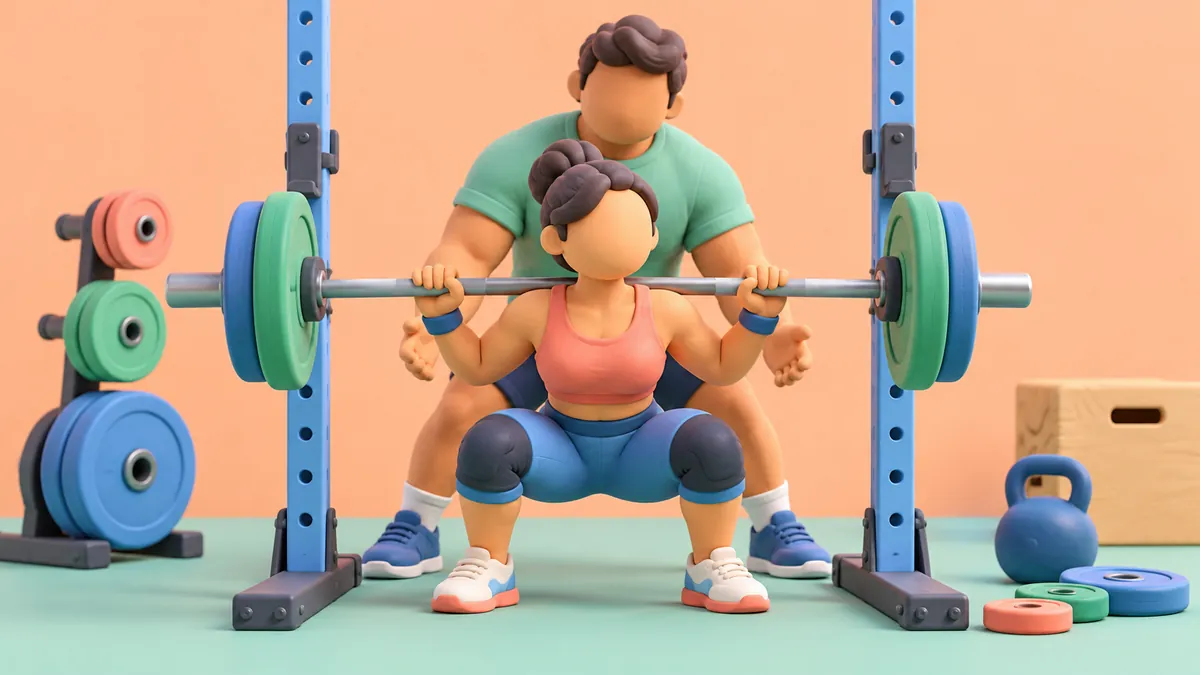
Increasing your one-rep max (1RM) is the cleanest measure of strength progress — and the easiest way to hurt yourself if you chase it badly. This tutorial walks through the principles that actually move 1RM, and the habits that keep you healthy while doing it.
Quick Answer
- Make the bulk of training submaximal volume at 70–85% of 1RM.
- Add load or reps progressively, not weekly heroics.
- Test 1RM every 4–8 weeks via a submaximal set + our One Rep Max Calculator — true max attempts are rare.
- Eat enough, sleep enough, and program a deload every 4–6 weeks.
Principle 1: Volume Builds Strength
Long-term strength gains come from accumulated quality volume, not occasional maxes. A typical productive week per main lift:
- 3–6 working sets at 70–85% 1RM
- 4–8 reps per set
- 1–3 reps in reserve (RIR) on most sets
That's 12–48 quality reps per week per lift — the engine of long-term progression. A single max attempt adds almost nothing.
Principle 2: Progressive Overload, Tiny Steps
The body adapts to demand. Add demand in small, repeatable increments:
- +2.5 kg per week on lower-body lifts (squat, deadlift)
- +1.25 kg per week on upper-body lifts (bench, press) — or +1 rep per set if weight stalls
- Double progression: hit the top of the rep range twice → bump weight
Skipping plates feels strong; it leads to injury and missed reps.
Principle 3: Manage Fatigue With RIR
Reps In Reserve (RIR) is a clean way to measure how hard each set is:
- RIR 3 — fast bar, easy
- RIR 1–2 — productive
- RIR 0 (true grind) — high cost, save for tests
Most working sets should be RIR 1–3. Pushing all sets to RIR 0 looks tough and produces less, because recovery between sessions tanks.
Principle 4: Test 1RM Without True Maxes
Rather than risking a true max attempt:
- Warm up thoroughly (5–7 min general + 4–6 progressive sets)
- Pick a weight you can do for ~5 reps with 1–2 RIR
- Perform the set cleanly
- Plug into our One Rep Max Calculator
- Use the average of Epley, Brzycki and Lombardi as your training reference
Accuracy: typically within ±5% of a true max for trained lifters.
Principle 5: Eat and Sleep for Strength
Strength gains need biological support.
- Calories: usually maintenance or a slight surplus (+150–250 kcal/day) — see Calorie Calculator
- Protein: 1.6–2.2 g/kg/day — see Macro Calculator
- Sleep: 7–9 hours; strength drops measurably after one poor night
Cutting aggressively while chasing 1RM rarely works for long; pick one focus at a time, or accept slow strength progress in a cut.
Principle 6: Program Deloads
Every 4–6 weeks of hard training, take a deload week:
- 50–60% of normal sets, same weights — or
- Same sets, 70% of normal weights
Deloads aren't lazy — they're how the body actually consolidates the previous weeks. Skipping them leads to stalled lifts and creeping joint pain.
A Simple 12-Week Strength Block
For an intermediate lifter aiming to put 5–10% on their main lifts:
- Weeks 1–4 — Heavy 5s and 6s at 80–85% (3–5 sets), RIR 1–2
- Week 5 — Deload (50% volume)
- Weeks 6–9 — Heavier 3s and 4s at 85–90% (3–5 sets), RIR 1
- Week 10 — Deload
- Weeks 11–12 — Top single at 90–93% RIR 1, then back-off sets
- End of week 12 — Submaximal test → new 1RM via calculator
The progression is gradual, the test is honest, and joints stay healthy.
Form Comes First
Lifting heavier doesn't help if technique breaks. Quick checklist for the big lifts:
- Squat: brace, knees track over toes, controlled descent, drive heels through floor.
- Deadlift: bar over mid-foot, neutral spine, lats engaged, push the ground away.
- Bench: scapulae retracted and depressed, feet planted, controlled bar path.
- Overhead press: glutes tight, ribs down, bar path vertical through your face.
If form breaks at a load, drop the load until it doesn't.
Periodisation: Linear, Undulating, Block
How you arrange volume and intensity across weeks decides whether you peak or plateau. Three common models work for natural lifters chasing 1RM:
- Linear periodisation — start a block at moderate intensity (70–75% 1RM, sets of 6–8), and shift gradually toward heavier triples and singles (85–92%) over 8–12 weeks. Simple, predictable, and ideal for late-beginner to early-intermediate lifters.
- Daily undulating periodisation (DUP) — within the same week, hit a heavy day (3–5 reps at 85%+), a moderate day (5–8 reps at 75–80%), and a lighter volume day (8–10 reps at 65–70%). DUP suits intermediates who stall on pure linear plans.
- Block periodisation — dedicate 3–5 weeks to one quality at a time: accumulation (volume), transmutation (strength), and realization (peaking). Cleaner for advanced lifters managing higher fatigue.
Pick one and follow it for at least one full block before switching. Jumping models every few weeks is how lifters spin their wheels for years.
Diagnosing a 1RM Plateau
When the bar stops moving up, the cause is almost never "you need to push harder." Run this checklist before changing the program:
- Technique drift — film a working set from the side. Stalled squats often hide forward bow; stalled benches hide elbow flare or a lost arch. Fixing a leak can add 5–10% overnight.
- Volume too low or too high — if you only hit one or two hard sets per lift each week, add a second or third session. If every session leaves you wrecked for two days, cut a set or two.
- Recovery debt — chronic sleep under 7 hours, calories under maintenance, or 60-plus hours per week of physical work all cap strength gains. Audit these before adding training stress.
- No deload in 8 weeks — fatigue accumulates silently. A planned light week often unlocks the lift that "wasn't moving" for a month.
- Wrong rep range for your level — beginners gain on 5s; intermediates often need triples and doubles to break through. If every set has been 5 reps for a year, try 3s at slightly heavier loads.
Change one variable at a time and give it 3–4 weeks. Changing four things at once tells you nothing about what worked.
Equipment and Setup for Heavy Attempts
Gear does not replace training, but the right setup keeps force where it belongs — in the bar.
- Lifting shoes — a hard, flat sole (or a raised heel for squats) gives a stable base. Running shoes compress under load and leak power on every rep.
- Belt — useful above roughly 80% 1RM on squats and deadlifts. Brace into the belt, not just against it; a belt amplifies intra-abdominal pressure, it doesn't create it.
- Wrist wraps — helpful on heavy benches and overhead presses to keep the wrist stacked under the bar.
- Knee sleeves — warmth and proprioception on heavy squats; not a substitute for a proper warm-up.
- Chalk and straps — chalk for raw grip on deadlifts and pulls; straps for high-rep work where the grip would fail before the target muscle.
- Bar setup — check the bar is centered, plates are matched, and collars are locked. A small imbalance feels enormous near a max.
Rehearse your full setup ritual on warm-up sets so it's automatic when the weight is heavy. Setup includes foot position, bar grip width, breath timing, and the cue you'll use to start the lift. Top lifters look almost robotic on max attempts because every variable except the weight has been removed.
A final note on the platform itself: clear the area before a heavy single, kick stray plates out of your walkout, and know where the safety pins or spotter arms sit. Decisions made calmly during warm-ups protect you when adrenaline narrows your focus near a true max.
Common Mistakes
- Maxing out frequently. True max attempts are systemic; do them rarely.
- Skipping warm-ups. Cold lifts under heavy load are the most common injury setup.
- Adding 5 kg every session. Linear progression that fast breaks within weeks for intermediates.
- Cutting hard while chasing PRs. Strength and fat loss compete for energy and recovery.
- Ignoring assistance work. Compound lifts thrive when supported by row volume, hamstring work, triceps and core.
Frequently Asked Questions
How long to add 10% to a major lift?
For an intermediate lifter, 3–4 months of consistent training and nutrition. Beginners often see faster relative gains; advanced lifters see slower.
Should I test 1RM monthly?
Submaximal estimation (a clean 3–6 rep set + calculator) is fine monthly. True max attempts: a few times a year at most, ideally for meet prep.
Are RPE-based plans better than percentage-based?
For most intermediates, RPE/RIR is more adaptive day to day. Percentage-based plans work well when paired with planned deloads.
Do I need a belt and straps?
A belt helps stabilise the trunk on near-max squats and deadlifts above ~80% 1RM — many lifters do all working sets beltless. Straps protect the grip on heavy pulls and high-rep deadlifts. Both are tools, not crutches.
Is one-rep-maxing safe at home?
If you train alone with no spotter, prefer submaximal estimation. Heavy bench without a spotter or safety pins is genuinely dangerous; squats less so but still risky.
Bottom Line
To put weight on your 1RM safely:
- Train submaximal volume at 70–85% with reps in reserve.
- Progress in small steps (1–2.5 kg or +1 rep).
- Eat enough and sleep enough — see Calorie and Macro Calculator.
- Deload every 4–6 weeks.
- Estimate 1RM with our One Rep Max Calculator — save true maxes for rare, well-prepared days.
Strength is patient. Patient lifters set PRs forever.
Health and fitness calculations are estimates only and not medical advice. Anyone with joint, back or cardiovascular issues should work with a qualified coach or physiotherapist before chasing heavy weight.