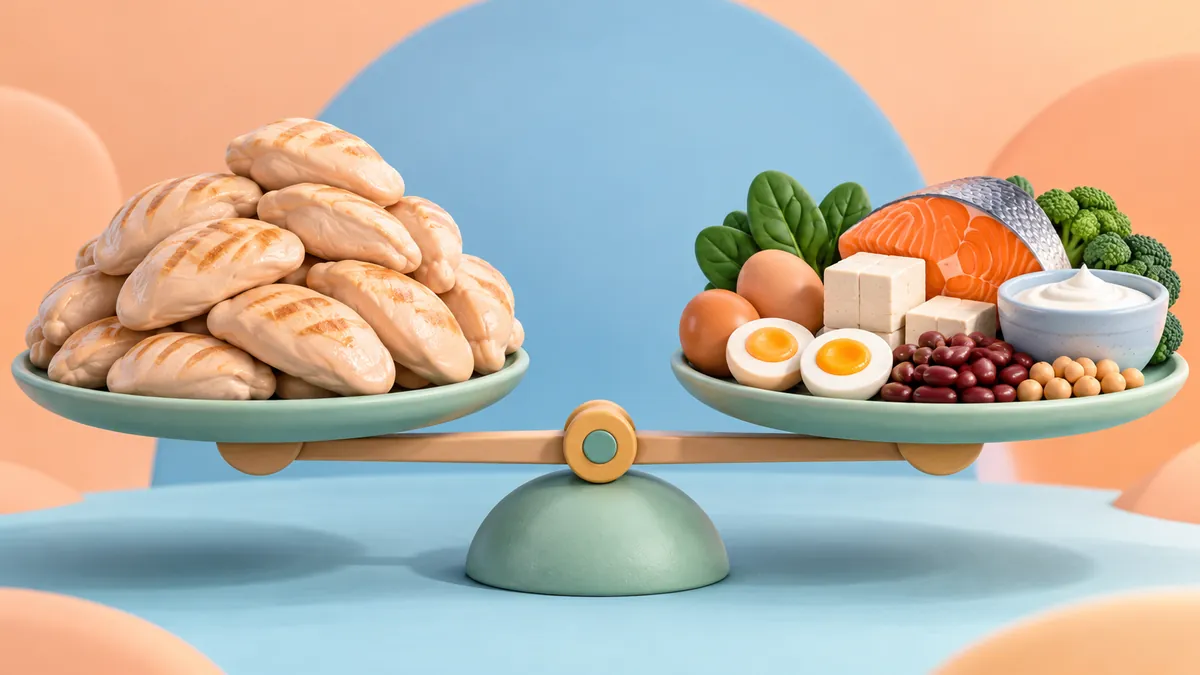
Most arguments about "the best protein source" miss the part that actually decides the outcome: total intake. Once you are eating enough — say 1.6 to 2.2 g of protein per kg of body weight, spread across several meals — the differences between whey, chicken, soy and pea start to shrink quickly. But the moment you eat less, or rely on one plant source, or you are an older adult with a blunted anabolic response, quality moves to the front of the line. This guide unpacks what protein quality means, how it interacts with quantity, and how to choose sources for your diet without overthinking it.
Quick Answer
- Quantity first, quality second for omnivores hitting 1.6 g/kg or more from varied foods. The quality differences mostly wash out.
- Quality starts mattering when total intake is low, when you eat only plant proteins, or when you are over 60.
- Leucine per meal is the single most useful quality marker — aim for roughly 2.5 to 3 g of leucine in each protein-anchored meal to fully trigger muscle protein synthesis (MPS).
- Animal sources are denser in leucine and have more complete amino-acid profiles. Plant sources work well when blended (rice and beans, pea plus rice powder) and dosed slightly higher.
- Plug your total target into the Macro Calculator, then use the source hierarchy below to fill it.
What "Protein Quality" Actually Measures
When nutrition scientists talk about quality, they mean two things:
- Amino-acid completeness — does the protein contain all nine essential amino acids in roughly the proportions your body needs?
- Digestibility — what fraction of those amino acids actually ends up absorbed and available, rather than passing through the gut?
Several scoring systems try to summarize both. The three you will run into are PDCAAS, DIAAS and Biological Value.
PDCAAS (Protein Digestibility-Corrected Amino Acid Score)
The older label-standard system. It rates proteins from 0 to 1.0 and caps high-quality proteins at exactly 1.0. Whey, eggs, milk and soy all score the maximum, which makes PDCAAS poor at distinguishing among top sources.
DIAAS (Digestible Indispensable Amino Acid Score)
The current gold standard from the FAO. DIAAS removes the cap, measures digestibility in the small intestine, and lets proteins score above 100%. Whey concentrate lands near 100 to 110, milk around 115, soy isolate around 90, pea isolate 80 to 90, and wheat protein near 40 to 50. DIAAS exposes the real gap between animal and plant proteins that PDCAAS hides.
Biological Value (BV)
Tracks how much absorbed nitrogen is retained. Whole egg sits near 100, whey around 104, beef near 80, soy near 74. Treat it as a rough rank, not a precise number.
| Source | DIAAS (approx) | Practical reading | |---|---|---| | Whey isolate | 100–115 | Top-tier, leucine-rich | | Whole egg | 105–115 | Top-tier, complete | | Milk / casein | 110–120 | Top-tier, slow release | | Beef / chicken / fish | 90–110 | Excellent, slightly behind dairy | | Soy isolate | 85–95 | Best plant option | | Pea isolate | 80–90 | Strong plant option | | Rice protein | 60–70 | Low in lysine; blend it | | Wheat / gluten | 40–55 | Low in lysine; not for muscle building alone |
Numbers vary by study; the ranking is more reliable than any single score.
The Leucine Threshold and Why Per-Meal Dose Matters
Of the nine essential amino acids, leucine is the trigger for muscle protein synthesis. The "leucine threshold" hypothesis says each protein-anchored meal needs enough leucine to flip the MPS switch, after which adding more leucine inside the same meal yields little extra.
Research suggests this threshold sits in the 2.5 to 3 g of leucine per meal range for younger adults, and closer to 3 to 4 g for adults over 60 (the so-called anabolic resistance of aging).
Here is the practical part. The leucine content of a 30 g serving of protein depends heavily on the source:
| Source (30 g protein serving) | Approx leucine | |---|---| | Whey isolate | 3.0–3.4 g | | Beef / chicken | 2.4–2.7 g | | Whole egg | 2.4–2.6 g | | Greek yogurt | 2.2–2.5 g | | Soy isolate | 2.2–2.5 g | | Pea isolate | 2.0–2.3 g | | Tofu / tempeh | 1.8–2.2 g | | Lentils / beans | 1.6–2.0 g | | Rice (cooked, per 30 g protein) | 1.7–2.0 g |
A 25 g whey shake crosses the leucine threshold easily. A 25 g lentil-only meal does not — you would either need closer to 35 to 40 g of plant protein, or you would pair the lentils with a leucine-richer source like dairy or a pea isolate top-up.
This is why plant-based lifters often run a 10 to 20 percent higher total protein target: it brings each meal back above the leucine line without forcing pure-isolate eating.
Animal vs Plant Sources — Where the Gap Lies
The honest summary: on a gram-for-gram, single-source basis, animal proteins are higher quality. They have more leucine per gram, more complete amino profiles in one food, and better small-intestine digestibility.
The size of the gap is smaller than internet debates suggest, though, and it closes quickly when you do two things:
- Eat more total protein — an extra 15 percent for plant-heavy diets is a reasonable rule of thumb.
- Blend sources so amino-acid weaknesses in one are covered by another.
Where plant proteins fall short most often:
- Lysine is low in grains (rice, wheat, oats, corn).
- Methionine is low in legumes (beans, lentils, peas, soy).
- Leucine is mildly low across most plants except soy and pea isolates.
Pair the two food families and the deficits cancel.
Plant Protein Blending — Making Incomplete Complete
The "complete vs incomplete" framing on older nutrition labels was always too binary. Almost every plant food has some of every essential amino acid; some just have less of one or two. The fix is not exotic — it is eating two plant families across the same day (you do not even need them in the same meal).
Classic complementary pairs:
| Limiting amino acid covered | Pair | |---|---| | Lysine (grain) + methionine (legume) | Rice and beans, hummus and pita, peanut butter on whole-grain bread | | Methionine (legume) + lysine (grain or seed) | Lentils with rice, tofu stir-fry over quinoa | | Both in one food | Soy (tempeh, edamame, tofu), quinoa, buckwheat, hemp seeds |
Three foods that quietly carry plant eaters across the line on their own:
- Soy products (tempeh, tofu, edamame, soy isolate) — complete profile, leucine in the upper plant tier.
- Quinoa — complete profile in a single grain, though lower in total protein than legumes.
- Pea isolate powder — close to soy in DIAAS, very useful for hitting the leucine threshold on shakes.
If your daily diet already includes a grain, a legume, and a soy or pea-based product, amino-acid completeness is essentially solved.
Whey vs Casein vs Plant Powders
Protein powders are a tidy place to see quality differences because the dose is precise. Here is a working comparison.
| Powder | Digestion speed | DIAAS (approx) | Leucine per 30 g | Best use | |---|---|---|---|---| | Whey isolate | Fast (1–2 h peak) | 100–115 | 3.0–3.4 g | Post-workout, between meals, default option | | Whey concentrate | Fast (1–2 h peak) | 95–105 | 2.7–3.1 g | Cheaper everyday choice | | Casein | Slow (5–7 h release) | 110–120 | 2.5–2.8 g | Pre-bed, long gaps between meals | | Soy isolate | Moderate | 85–95 | 2.2–2.5 g | Best single-source plant powder | | Pea isolate | Moderate | 80–90 | 2.0–2.3 g | Soy-free plant option | | Pea + rice blend | Moderate | ~90 | 2.2–2.5 g | Closes the amino gap better than either alone |
For most lifters, whey concentrate is the value pick. For plant-based athletes, a pea-and-rice blend at 35 to 40 g of powder closes most of the quality gap on a single shake. Casein gets recommended pre-bed for its slow release — the overnight effect is modest, but a casein-rich snack helps if you train late.
When Quality Trumps Quantity
There are scenarios where the source matters as much as the total. Treat quality as a first-class concern if you fall into any of these:
- Adults over 60. Anabolic resistance raises the per-meal leucine threshold. Higher-quality sources (whey, dairy, eggs, lean meat) hit the threshold without inflating calories.
- Vegan athletes. No dairy or eggs to backstop a low-quality meal. Soy, pea isolate, tempeh, and grain-legume pairing become essential rather than optional.
- Low-calorie cuts. At 1,400 to 1,800 kcal, every gram pulls its weight. Lower-quality sources force you to eat more total grams to hit the same amino-acid target.
- Injury recovery and single-meal-a-day patterns. Both push the per-meal leucine dose to the front. Pick sources that clear the line in one serving.
When Quantity Trumps Quality
For most lifters with reasonably varied diets, the math runs the other way. If you are an omnivore eating 1.8 to 2.2 g/kg from a mix of meat, dairy, eggs and some plants, the source differences mostly disappear. You will:
- Cross the leucine threshold easily in every meal.
- Get all essential amino acids in surplus.
- Not see any measurable difference between, say, chicken and Greek yogurt as your dinner protein.
In this regime, add total grams before you obsess about source. Switching from chicken to whey will not make a visible difference; going from 1.2 g/kg to 1.8 g/kg will.
The same applies to budget-driven eating. Eggs, milk, canned fish, ground beef, and a tub of whey concentrate cover the quality side cheaply. You do not need premium grass-fed cuts or a stack of EAA pills to make muscle.
Practical Source Hierarchy for Different Diets
Pick the list that matches your eating pattern and rotate within it.
Omnivore
- Lean meat, poultry, fish — daily anchor
- Dairy (Greek yogurt, cottage cheese, milk) — high leucine, easy to dose
- Eggs — complete profile, cheap
- Whey or casein powder — convenience top-up
- Legumes and soy — fiber and variety
Lacto-ovo vegetarian
- Greek yogurt, cottage cheese, milk — leucine workhorses
- Eggs — complete profile, easy to dose
- Soy products (tempeh, tofu, edamame) — best non-dairy quality
- Whey or casein powder — single biggest leverage point
Vegan
- Soy products (tempeh, tofu, edamame, soy isolate) — high-quality plant base
- Pea isolate powder, ideally blended with rice protein
- Legumes plus grains, eaten across the same day
- Quinoa, buckwheat, hemp seeds — complete in one food
Vegan athletes hitting 2.0 to 2.4 g/kg with these are not at any meaningful disadvantage compared with omnivores at 1.8 g/kg. The protocol is just slightly more intentional.
Putting It Into Practice
A workable approach for a 75 kg lifter targeting 160 g of protein:
- Set the total. Run the numbers through the Macro Calculator and lock the protein figure. If you want to base it on lean mass, get a body-fat estimate from the Body Fat Calculator first.
- Anchor 3 to 5 meals with 30 to 40 g of protein each. Make sure each meal independently clears the leucine threshold — usually at least one high-quality source per meal.
- Choose your base source. Omnivores default to lean meat or dairy; vegetarians lean on dairy plus soy; vegans build around soy or pea-blend powder.
- Add a convenience source. A scoop of whey or pea-rice blend turns any low-protein meal (oats, soup, smoothie) into a complete one.
- Confirm energy needs with the TDEE Calculator and adjust carb and fat targets around the protein floor.
For a refresher on macros in general, the macronutrient guide covers protein, carbs and fat at a beginner-friendly level.
Frequently Asked Questions
Can vegans get enough quality protein for muscle building?
Yes, comfortably. The recipe is: hit a slightly higher total target (around 2.0 to 2.4 g/kg), use soy or pea-rice powder once or twice a day, and combine legumes with grains at most meals. Vegan bodybuilders win competitions on this approach — it is more about planning than about a lower ceiling.
Is whey really better than plant protein?
On a per-gram, single-source basis, yes — whey has more leucine and higher digestibility, and DIAAS reflects that. In the context of a full day, the gap shrinks fast. If you eat plant protein in slightly larger amounts and blend sources sensibly, the muscle-building outcome is essentially the same.
How much leucine do I need per meal?
Roughly 2.5 to 3 g per meal for adults under 60, and 3 to 4 g per meal for older adults. A 25 to 30 g serving of whey, dairy or lean meat clears that easily. A pure-legume meal often does not; pair it with a leucine-richer source or dose the meal a bit higher.
Are BCAAs or EAAs worth taking on top of whole protein?
If you already hit your daily target with real food and a normal protein powder, no. BCAAs and EAAs are already inside any complete protein you eat. The marginal benefit on top of a well-built diet is essentially zero, and BCAA-only products miss six of the nine essential amino acids.
Does protein quality matter more in a calorie deficit?
Yes, modestly. When total calories drop, the cost (in calories and stomach space) of relying on low-quality sources rises. A higher-quality protein base — lean meat, dairy, eggs, whey, soy or pea isolate — lets you protect muscle on fewer total grams during a cut.
Is there any downside to mixing animal and plant proteins?
None. Mixing tends to improve a meal's amino-acid profile compared with either alone. Most traditional cuisines do this naturally — rice and fish, beans and meat, yogurt and lentils.
Conclusion
Protein quality is real, but second-order for most people. Get your total right first, anchor 3 to 5 meals that each clear the leucine threshold, and pick sources matching your dietary pattern. Omnivores can be casual about source choice once total intake is on point. Plant-based eaters, older adults, and low-calorie dieters get more leverage from focusing on quality and blending sources. The lifters who win hit their numbers day after day, not the ones chasing a perfect amino-acid profile in any single meal.
Health and nutrition calculations are estimates only and not medical advice. If you have kidney or liver disease, are pregnant, or follow a medically prescribed diet, consult a registered dietitian before significantly changing protein intake or source mix.