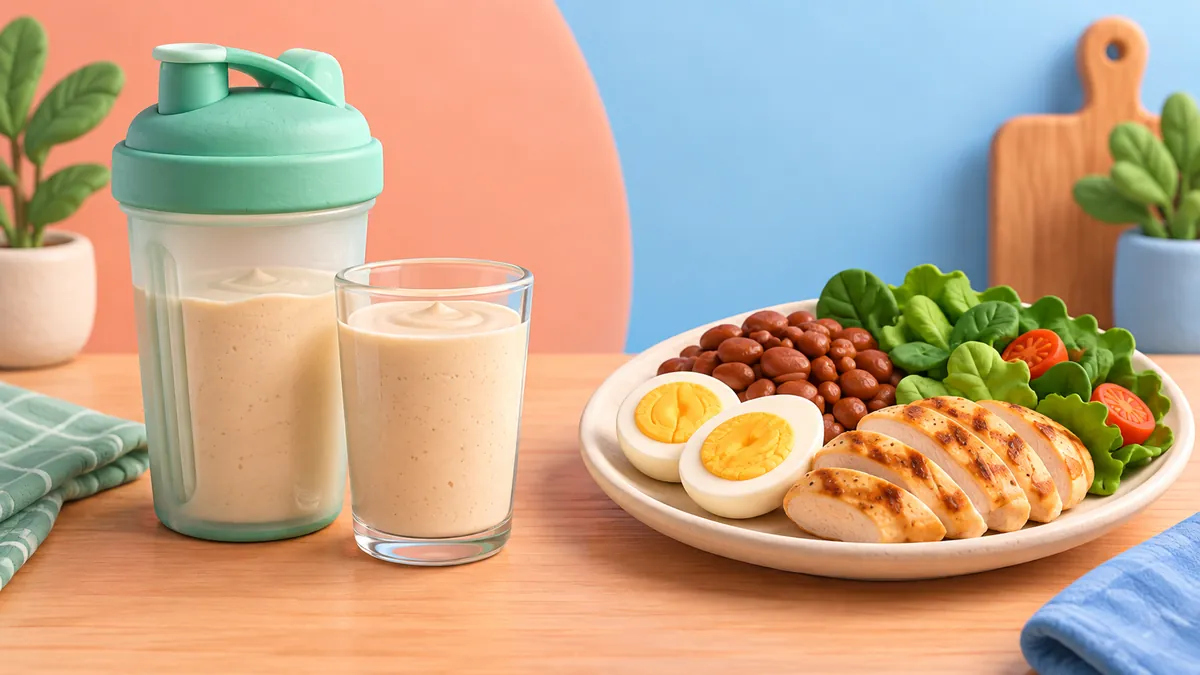
Picture two lifters. One keeps a shaker bottle and a tub of whey in the gym bag at all times. The other meal-preps four pounds of chicken breast every Sunday and never touches a powder. Both can build the same physique. The shake-versus-real-food debate gets framed as if you have to pick a side, but the honest answer is that they are different tools that solve different problems. Shakes win on convenience and cost per gram. Whole foods win on satiety and nutrient density. For hypertrophy, when total protein and amino acids are equated, the two are essentially tied. This guide breaks down where each option actually pulls ahead so you can use both intelligently.
Quick Answer
| Dimension | Protein shakes | Whole food protein | |---|---|---| | Hypertrophy (amino-acid equated) | Equal | Equal | | Satiety per gram | Lower | Higher | | Nutrient density (micros, fiber, phytochemicals) | Low | High | | Convenience and portability | High | Moderate to low | | Cost per 25 g of protein | Around 0.50 to 1.00 USD | Around 1.50 to 3.00 USD | | Leucine per 25 g serving | 2.5 to 3.0 g (whey) | 2.0 to 2.7 g (meat, dairy, eggs) | | GI tolerance for some users | Variable; whey lactose can bother some | Generally well tolerated |
- For pure muscle growth, use whichever lets you hit your daily protein target consistently.
- For fat loss and adherence, lean on whole foods because they keep you fuller per calorie.
- For hectic days and travel, shakes are the rescue tool — not a virtue, just a logistic.
- Plug your daily target into the Macro Calculator first, then decide how to split it between food and powder.
Are Protein Shakes Actually Faster-Absorbing?
Yes, but the gap matters less than the marketing suggests. Whey protein in a liquid empties from the stomach quickly and shows up in the bloodstream within roughly 30 minutes, peaking around 60 to 90 minutes. Solid protein from chicken, beef, or eggs comes in slower and steadier, with aminoacidemia spread across 3 to 5 hours.
Whey produces a sharper amino-acid spike, often cited at around 8 to 10 grams per hour of amino-acid appearance during the peak window. Solid food gives you a gentler curve. The leucine peak from whey is higher, the insulin response is faster, and muscle protein synthesis (MPS) rates briefly look steeper on paper.
Here is the catch: across a full day, both curves deliver enough amino acids to maximally stimulate MPS at every meal, as long as each serving clears the leucine threshold of roughly 2.5 to 3 g. The shape of the curve is interesting biochemistry; it is not the deciding factor in muscle growth.
If you trained fasted and need amino acids in your blood quickly, a whey shake is genuinely the fastest option. If you ate a normal meal containing 25 to 40 g of mixed protein within the prior 3 hours, you already have plenty of amino acids circulating, and the speed advantage of a post-workout shake mostly disappears.
Hypertrophy: The Evidence Says Equated Sources Are Equal
Meta-analyses on protein source and muscle growth tell a remarkably consistent story. When studies match total protein intake, total calories, and training load, the choice between whey, casein, beef, milk, soy, or a plant blend produces small to no differences in lean mass or strength outcomes. The early advantages whey shows in short-term acute studies tend to wash out over 8 to 12 weeks of equated training.
The pattern most lifters miss: the source argument matters most when intake is low. At 0.8 g/kg of body weight, the gap between a high-leucine source like whey and a lower-leucine source like rice protein is meaningful. At 1.8 to 2.2 g/kg from a varied diet, the gap effectively closes.
For a deeper dive into how quality and quantity interact, the protein quality and quantity guide walks through DIAAS scoring and the leucine threshold in detail. The short version: get your total right, anchor 3 to 5 meals at 30 to 40 g of protein each, and shake-versus-real-food becomes a logistics decision rather than a hypertrophy one.
Where Whole Food Wins: Satiety
Solid protein keeps you fuller, gram for gram, than the same protein consumed as a shake. Three mechanisms drive this gap.
- Chewing time. The act of chewing extends the meal, allowing satiety hormones like CCK and PYY to ramp up before you have finished. A 250-calorie chicken breast takes 5 to 8 minutes to eat. A 250-calorie shake is gone in 60 seconds.
- Gastric distension. Solid food occupies more stomach volume per calorie. Stretch receptors in the stomach lining signal fullness to the brain. Liquids pass through faster and trigger less of this signal.
- Hormonal response. Mixed solid meals produce a stronger and more sustained CCK and GLP-1 response than isolated protein drinks. The hormonal "I am full" signal lasts longer.
The practical impact shows up most during fat loss. In a calorie deficit, hunger is the single biggest predictor of whether a diet sticks. Replacing two whole-food meals with shakes can save time, but it often costs you 200 to 400 calories of extra snacking later in the day because the hunger came back early.
If you are cutting and struggling with adherence, the first thing to do is move shake calories back into chewed meals, not to lower your protein target. A chicken-and-vegetables plate at 400 calories will outlast a 400-calorie shake by hours.
Where Whole Food Wins: Nutrient Density
A scoop of whey delivers protein and not much else. A piece of salmon delivers protein plus omega-3 fats, vitamin D, B12, selenium, and iodine. A bowl of Greek yogurt with berries delivers protein plus calcium, probiotics, polyphenols, and fiber. The micronutrient ledger is not close.
Whole foods give you:
- Micronutrients that are either absent or token amounts in powders — iron from red meat, choline from eggs, zinc from shellfish, B vitamins from dairy.
- Fiber from legume- and grain-based proteins, which most powdered products strip out during isolation.
- Phytochemicals and bioactive compounds in plant proteins like tofu, tempeh, and edamame — isoflavones, lignans, polyphenols — that you simply do not get from isolate.
- Food matrix effects. The combination of protein with fats, carbs, and micros in a whole food may modulate absorption and metabolic response in ways isolated protein powders do not replicate.
You can backfill some of this with a multivitamin and a fish oil cap, but most people who lean heavily on shakes end up under-eating fiber, omega-3s, and vitamin D unless they are deliberate about it. If your diet is already 60 percent shake-derived, the first fix is to swap one shake per day for a whole-food meal, not to add more supplements.
For a broader framework on building meals around protein anchors, see the protein intake guide for muscle building.
Where Shakes Win: Convenience and Cost
This is where the math flips, and it flips hard. On a cost-per-25-grams-of-protein basis, a tub of whey concentrate runs roughly 0.50 to 1.00 USD per serving in most markets. Chicken breast lands closer to 1.50 to 2.50 USD per 25 g. Lean beef, salmon, and Greek yogurt all sit higher, sometimes 2 to 4 USD per equivalent serving.
Prep time tells the same story. A shake is 30 seconds — scoop, water, shake, done. A protein-anchored meal from scratch is 15 to 45 minutes of cooking plus cleanup. Meal prepping for the week amortizes the cost but still requires a 2- to 3-hour Sunday session.
The convenience picture:
- Portability. A shaker fits in any bag. Cooked chicken needs a cooler in summer.
- Travel. Hotel rooms rarely have stoves. A travel-size whey container plus a shaker covers protein anywhere.
- Time-crunched mornings. A breakfast shake at the desk beats skipping protein because eggs took too long.
- Between-meal gaps. A 25 g protein shake at 4 PM is a cleaner top-up than a fast-food stop on the way home.
- Post-workout in the gym parking lot. A shake on the drive home is more realistic than a whole meal you cannot cook for another hour.
Shakes are the right tool when the alternative is not whole-food protein — it is no protein at all.
Where Shakes Win: Hitting Daily Protein Targets
Here is the underappreciated argument for powders. If you weigh 80 kg and target 2.0 g/kg of body weight, that is 160 g of protein per day. Sourcing that from whole foods only is a real chewing job. Four full chicken-breast-sized meals plus snacks is roughly 700 to 800 grams of dense protein food, which can crowd out vegetables, carbs, and fats in a normal eating window.
Adding one or two 25 to 30 g shakes makes the math comfortable:
- 3 whole-food meals at 35 g each = 105 g
- 1 whey shake at 25 g = 25 g
- 1 Greek yogurt or cottage cheese snack at 30 g = 30 g
- Total = 160 g, with appetite and time both intact
For lifters over 90 kg targeting 180 to 220 g daily, doing this without any powder is technically possible but practically miserable. Most lifters at the higher body-weight end use 1 to 2 shakes per day not because they prefer shakes but because the daily total demands it.
The Macro Calculator gives you the daily protein figure. From there, decide how many whole-food meals you can realistically prepare and let shakes fill the gap.
Whey vs Casein vs Plant Blends
Within powders, the three options are not interchangeable. Quick comparison:
| Powder | Digestion speed | Cost | Leucine per 30 g | Best fit | |---|---|---|---|---| | Whey isolate | Fast (1 to 2 h peak) | Higher | 3.0 to 3.4 g | Post-workout, between meals, lactose-sensitive users | | Whey concentrate | Fast (1 to 2 h peak) | Lower | 2.7 to 3.1 g | Default daily driver, value option | | Casein | Slow (5 to 7 h release) | Moderate | 2.5 to 2.8 g | Pre-bed, long gaps between meals | | Pea + rice blend | Moderate | Moderate | 2.2 to 2.5 g | Plant-based or dairy-intolerant lifters | | Soy isolate | Moderate | Lower | 2.2 to 2.5 g | Budget plant option |
Whey concentrate is the value pick for omnivores who tolerate dairy. Whey isolate costs more but is lower in lactose and fat, useful if concentrate gives you bloating. Casein is worth keeping for late-night use only if you are training hard and the overnight fast is long. For plant-based eaters, pea-and-rice blends at 35 to 40 g of powder per serving close most of the amino-acid quality gap on a single shake. The vegan bodybuilding protein and supplements guide walks through the plant-side strategy in more detail.
Practical Strategy: A Hybrid Approach
For most lifters, the productive answer is not "shakes or whole food" but how to use both. A typical hybrid day for an 80 kg lifter at 160 g of protein:
- Breakfast (whole food, 35 g): Three eggs plus Greek yogurt, or oatmeal with cottage cheese.
- Mid-morning shake (25 to 30 g): Whey in water or milk, taken at the desk or between meetings.
- Lunch (whole food, 40 g): Chicken, fish, tofu, or lean beef with vegetables and a starch.
- Pre- or post-workout shake (25 g): Whey, especially if the meal-to-training gap is longer than 3 hours.
- Dinner (whole food, 35 g): Another lean protein with vegetables and a carb side.
That is 3 whole-food anchors plus 2 tactical shakes, hitting 160 g without forcing four full meals. The whole-food meals carry the micronutrients, fiber, and satiety. The shakes carry the convenience and the daily-total math.
Swap shakes around your schedule rather than at fixed times. The point is shake = rescue, not staple. When a meal would otherwise be skipped or be protein-light, use a shake. When you have time to cook and chew, use real food.
When Shakes Are the Wrong Tool
Powders are not free of downsides, and there are situations where they actively work against your goals.
- You are already under-eating. Replacing a 500-calorie chicken-and-rice meal with a 200-calorie shake widens an existing energy deficit. If you are struggling to gain weight, shakes can suppress appetite without delivering equivalent calories.
- You have satiety problems during a cut. As covered above, liquid calories register less in the satiety system. If your fat-loss diet is sticking poorly, removing one shake and adding back a whole-food meal often helps more than tweaking macros.
- You have blood sugar concerns. A whey-only shake in water has a sharper insulin and glucose impact than the same protein eaten with fat, fiber, and chewing time. Most healthy lifters do not need to worry about this, but for users with insulin resistance or reactive hypoglycemia, adding fat and fiber to the shake (peanut butter, oats, frozen berries) flattens the curve.
- You are concerned about ultra-processed intake. Protein powders sit in a gray zone. Whey isolate is a relatively simple ingredient — cow's milk filtered down to one protein fraction — but most powder products bundle in artificial sweeteners, gums, flavorings, and emulsifiers. If minimizing ultra-processed foods is a priority for you, a powder cap of 1 to 2 scoops per day plus a focus on whole foods is reasonable.
- You think a shake replaces post-workout food forever. The post-workout anabolic window guide covers why the urgency around immediate post-lift protein has been dramatically overstated. A shake right after lifting is fine; it is not magic, and a full meal within 2 hours does essentially the same job.
Frequently Asked Questions
Do I need a protein shake right after lifting?
No. The anabolic window stretches across several hours, not minutes. If you ate a protein-containing meal in the 2 to 3 hours before training, you have circulating amino acids covering your session and the early recovery period. If you trained fasted or it has been more than 4 hours since your last meal, a 25 to 40 g shake within an hour of finishing is reasonable but not urgent.
Are protein shakes ultra-processed?
Most flavored powders qualify as ultra-processed under standard food-classification systems because they contain isolated ingredients, added sweeteners, and stabilizers. Unflavored whey isolate is closer to a single-ingredient food. If processing is a concern, you can buy unflavored whey or casein, mix with milk and a banana, and end up with something much closer to a homemade meal in composition.
Can I replace meals with shakes long-term?
You can sustain it nutritionally if you supplement carefully and pick high-quality powders, but most people find satiety and adherence problems within a few months. A reasonable ceiling for most lifters is 1 to 2 shakes per day, with whole-food meals carrying the bulk of intake. Going much higher long-term tends to under-deliver on fiber, micronutrients, and meal satisfaction.
Is whole food protein better for fat loss?
For most dieters, yes — primarily because of satiety. Whole food fills you up per calorie better than shakes, which translates to easier adherence in a deficit. Shakes can still play a tactical role during a cut (post-workout, between meetings) but the bulk of your protein should come from chewed meals when hunger is the limiting factor.
Are mass gainer shakes worth it?
Rarely, and almost never at the high end of the market. Mass gainers are typically a moderate dose of cheap protein plus a large dose of maltodextrin and added oils, sold at a premium. You can build a homemade equivalent for half the cost: whey concentrate, oats, peanut butter, whole milk, and a banana in a blender. If you genuinely cannot eat enough food, a homemade gainer shake helps. The commercial versions are mostly marketing.
Does drinking protein shakes cause kidney damage in healthy people?
No, based on current evidence. In adults with healthy kidney function, intakes up to roughly 2.5 to 3.0 g/kg have not been shown to harm kidney function in controlled studies. The concern applies primarily to people with pre-existing chronic kidney disease, who should work with a nephrologist on protein targets regardless of source.
Is whey safe for lactose-intolerant users?
Often yes, especially with whey isolate. Isolate is filtered to remove most lactose, leaving roughly 0.5 to 1 g per serving — well below the typical tolerance threshold for mild intolerance. Whey concentrate retains more lactose (4 to 5 g per serving) and bothers more users. If dairy products generally upset your stomach, try a single scoop of isolate first; if that also fails, move to a pea-rice blend.
Should I use a shake to hit the leucine threshold at breakfast?
It is a useful trick. A typical breakfast like cereal with milk, or toast with eggs, often lands at 12 to 20 g of protein and around 1.5 to 2.0 g of leucine — under the threshold for a strong MPS response. Adding a scoop of whey to milk or yogurt at breakfast pushes the meal cleanly across the line and is one of the highest-leverage uses of a shake in a normal day.
The Bottom Line
Stop treating shakes and whole foods as rivals. They serve different jobs:
- Hypertrophy: equal when amino acids are matched. Source choice is a logistics question, not a results question.
- Satiety and adherence: whole food wins, and the gap is significant during fat loss.
- Nutrient density: whole food wins. Shakes are macros, not nutrition.
- Convenience and cost: shakes win, often by a wide margin.
- Daily protein target math: shakes make ambitious totals practical without forcing 5 full cooked meals.
For most lifters, the winning structure is 3 whole-food protein-anchored meals plus 1 to 2 tactical shakes. Adjust the ratio toward whole food during fat loss for satiety, and toward shakes during travel or hectic weeks for sustainability. Pick the tool the situation needs, and let the daily total decide your physique — not which container the protein came from.
Consult a healthcare provider before high-dose supplementation, especially if you have kidney concerns or take medications.