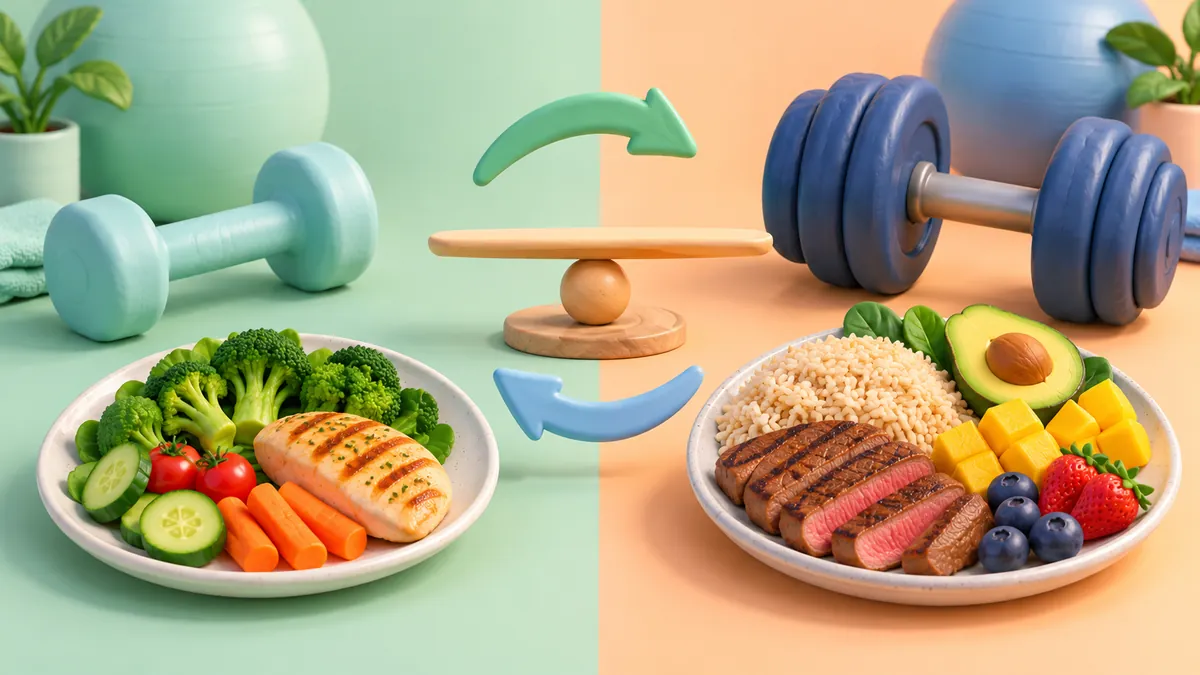
Cut to lose fat. Bulk to build muscle. The two phases share a calculator but use opposite calorie strategies and slightly different macro emphasis. This guide compares them side by side — when to pick each, what the numbers look like, and how to switch between them without losing your progress.
Quick Answer
| Aspect | Cut | Bulk | |---|---|---| | Calories | TDEE − 300 to 700 | TDEE + 200 to 500 | | Protein | higher (1.8–2.4 g/kg) | 1.6–2.0 g/kg | | Fat | 0.6–1.0 g/kg | 0.8–1.2 g/kg | | Carbs | fill the rest (lower) | fill the rest (higher) | | Training | preserve muscle | drive growth | | Length | 8–16 weeks | 12–20 weeks | | Rate | 0.5–1% body weight/week | 0.25–0.5% body weight/week |
Pick the phase that matches your current body composition — and the right calorie split with our Macro Calculator.
When to Cut
Cut when:
- Body fat percentage is above 15% for men or 25% for women and a leaner look is the priority
- Daily energy and gym performance are fine
- You can commit 8–16 weeks of disciplined eating
A focused cut beats a half-hearted recomp for visible change.
When to Bulk
Bulk when:
- Body fat is under ~15% for men / ~22% for women and you want more muscle
- Strength has plateaued for 8+ weeks at maintenance
- You can commit 12–20 weeks; aesthetic preference allows some fat gain
A lean bulk (+200–300 kcal) preserves the visible look while adding muscle. A traditional bulk (+500 kcal) gains faster but adds more fat per kilo of muscle.
When to Recomp Instead
If you're in the beginner phase, returning to training, or sitting at higher body fat with limited muscle, recomp (calories near maintenance + high protein + lifting) usually outperforms both. See our Body Recomposition guide.
Cut: Macro Strategy
Lock protein first to spare muscle.
For a 70 kg lifter at maintenance ≈ 2,500 kcal, cutting at −500:
- Target: 2,000 kcal/day
- Protein: 70 × 2.0 = 140 g (~560 kcal)
- Fat: 70 × 0.7 = 49 g (~441 kcal)
- Carbs: (2,000 − 560 − 441) / 4 ≈ 250 g
In percentage: ~28% P / 22% F / 50% C. The exact percentages don't matter — the grams of protein and fat do.
Bulk: Macro Strategy
Slightly more permissive on fat and carbs; protein stays high but the absolute number doesn't change much.
Same 70 kg lifter, lean-bulking at +300 → 2,800 kcal:
- Protein: 70 × 1.8 = 126 g (~504 kcal)
- Fat: 70 × 1.0 = 70 g (~630 kcal)
- Carbs: (2,800 − 504 − 630) / 4 ≈ 417 g
The extra calories come from carbs (~115 g more) and fat (~21 g more). Protein essentially holds.
Cut: Training Strategy
The goal in a deficit is muscle preservation.
- Strength training 3–5 days/week is non-negotiable
- Keep working weights as close to pre-cut as possible
- 1–2 cardio sessions/week or daily steps for the calorie budget
- Expect 5–10% strength drop on some lifts at the deepest point of the cut
Bulk: Training Strategy
The goal in a surplus is stimulus and recovery.
- Strength training 3–5 days/week with progressive overload
- More volume tolerable (up to ~10 sets per muscle group per week, more for advanced)
- Limited cardio — enough for health, not enough to compete with muscle building
- Expect strength PRs across most lifts within 12 weeks
The Calorie Math Translated
For our 70 kg lifter at TDEE 2,500 over 12 weeks:
- Cut at −500/day: 12 × 7 × 500 / 7,700 ≈ 5.5 kg fat-loss potential (realistic outcome 4–5 kg with adaptation)
- Lean bulk at +300/day: 12 × 7 × 300 / 7,700 ≈ 3.3 kg total gain, of which roughly half is muscle, half is fat and water with smart execution
Cuts move the scale faster; bulks move the muscle. The hierarchy is goal-dependent.
The Mini-Cut: A Tactical Alternative
Not every cut needs to be 12 weeks. A mini-cut is a deliberately short, sharper deficit — usually 2–4 weeks at −700 to −1,000 kcal/day, then back to maintenance.
When it shines:
- Mid-bulk fat creep. Three months into a lean bulk, body fat is up 2 points and you want to extend the bulk without bloating further. Two weeks at a sharp deficit resets the look without losing the muscle momentum.
- Pre-vacation sharpening. Three to four weeks ahead of an event, a mini-cut can produce visible change without the hormonal weight of a full cut.
- Adherence breaks. Constant moderate restriction wears people down. A short, intense block can feel mentally easier than another two months of plodding.
Mini-cuts cost more strength per kilo than slow cuts — train through them at 80% volume, avoid PR attempts, and keep protein at the upper end (2.4 g/kg). They are a tool, not a default; running back-to-back mini-cuts is a recipe for burnout.
Reverse Dieting: Leaving a Cut Cleanly
The hardest part of a successful cut is not regaining the fat in the first six weeks afterward. Reverse dieting is the standard answer.
- Add 50–100 kcal per week to the cut-end intake, mostly from carbs, until you reach the new maintenance.
- Hold protein at the cut level — it should not drop.
- Expect the scale to climb 1–2 kg in the first two weeks (restored glycogen + water). That is not fat regain; it is the body un-depleting.
- Track strength every session. A sudden 10% strength jump usually marks the true maintenance number — that's where to settle.
Reverse dieting is not magic — it is just patience. People who skip it almost always overshoot maintenance by 300–500 kcal in week one and regain 3–4 kg before they catch the trend.
Switching Between Phases
Most lifters spend their fitness lives alternating phases. A simple cycle:
- 8–12 weeks cut → ~5% body fat loss
- 1–2 weeks maintenance → metabolic and adherence reset
- 12–16 weeks lean bulk → muscle gain with limited fat regain
- 1–2 weeks maintenance before next cut
Switching gradually (don't jump from 2,000 to 2,800 overnight) reduces water/scale chaos.
Signals the Phase is Running Too Long
Cuts and bulks both have a useful lifespan. Beyond it, returns drop and side effects climb. Watch for:
Cut too long:
- Resting heart rate trending down by 10+ bpm
- Persistent low mood, low libido, cold extremities
- Strength sliding on multiple lifts week-on-week
- Sleep degrading or hunger waking you at night
- Body fat scale loss stalls for 3+ weeks despite tracking
Bulk too long:
- Body fat percentage above your acceptance threshold (often 15% men / 22% women)
- Visible "soft" waistline and clothes fitting differently in unwelcome places
- Heartburn, sluggishness, snoring picking up
- Strength gains slowing despite the surplus — the body cannot use any more food productively
Two or more of these in the same week means the phase is past its useful life. Transition out via reverse dieting (after a cut) or a measured cut (after a bulk).
Refeeds and Diet Breaks
Long cuts benefit from structured refeeds — one or two days per week at maintenance carbs, with protein unchanged. The point is not the food; it's the hormonal lift (leptin nudges up, thyroid stays better, training quality recovers).
A practical rhythm:
- Weeks 1–4 of a cut: no refeeds needed.
- Weeks 5–8: add one refeed day per week — usually a hard training day.
- Beyond week 8: consider a full 7-day diet break at maintenance every 4–6 weeks until the cut ends.
Diet breaks are not "cheat weeks" — calories sit at honest maintenance, not surplus. Treat them as planned, not as relief.
Common Mistakes
Cutting
- Dropping protein along with calories. Keep protein high.
- Cutting too long. Beyond 12–16 weeks, adherence and hormones break down. Take a break.
- Cardio-only weight loss. Without lifting, more of the loss is muscle.
Bulking
- "Dirty bulking" with very high surpluses. Adds 3–4 kg of fat per kg of muscle. Cleaning that up later wastes months.
- Too little protein. Surplus calories without protein build more fat than muscle.
- Bulking from already-fat starting points. If you're over 20% body fat (men) / 28% (women), cut first.
Switching
- No transition week. Jumping straight from deficit to surplus causes a big water/scale swing that can break adherence.
- Bulking too soon after a cut. A short maintenance phase preserves the new baseline.
Frequently Asked Questions
How long should I bulk before cutting?
Until the rate of strength gain slows substantially (often 12–20 weeks for intermediates), or until body fat creeps above your acceptance threshold.
How fast should I cut?
0.5–1% of body weight per week for most lifters. Higher for higher-body-fat starters. Faster always costs more muscle.
Can I cut and gain strength?
Beginners and returning lifters often can. Intermediates and advanced lifters typically hold strength on most lifts and grind progress on a few — but don't expect across-the-board PRs in a real deficit.
Should bulking macros change with training day?
Optional. Slightly higher carbs on heavy training days, slightly lower on rest days, with the same weekly total — sometimes called calorie cycling — can help body composition.
How do I know it's time to cut?
When the look you want has slipped behind enough fat that another month of bulking moves the line further. Or when body fat exceeds your comfort threshold (~15% men / 22% women is a common stop).
Should I keep training the same in a cut vs. a bulk?
The exercise selection and rep ranges stay similar; the volume changes. In a cut, drop total weekly sets by 10–20% — recovery cannot keep up with full bulk volume in a deficit. In a bulk, add a set per main movement every 2–3 weeks until you hit your recovery ceiling, then hold.
What about water weight when switching phases?
A cut depletes glycogen, which carries roughly 3 g of water per g of glycogen. Refilling it in the first week of a bulk reverses 1–2 kg of "weight loss" on the scale — that is normal and expected. Don't panic-cut back into the deficit. Hold the new intake for 2 weeks and look at the trend.
Is the calorie target the same on training and rest days?
It can be — and that's the simplest starting point. Once you're consistent, calorie cycling (training-day +200, rest-day −200 from your average) improves body composition without changing the weekly total. Useful in both cuts and bulks once the basics are dialled in.
Bottom Line
The cut/bulk decision is not "which is better" — it's "which fits my goal right now."
- Set TDEE via the TDEE Calculator.
- Pick cut (−500) or lean bulk (+250–300), or recomp for the right profile.
- Lock the macros with the Macro Calculator.
- Train hard, eat enough protein, hold for 8–16 weeks.
- Transition with 1–2 weeks at maintenance before flipping phases.
The body responds to the food you give it. The right food, in the right phase, for long enough — that's the whole formula.
Health and fitness calculations are estimates only and not medical advice. Long deficits, very high surpluses or repeated phase-switches are best supervised when you have a chronic condition or eating disorder history.