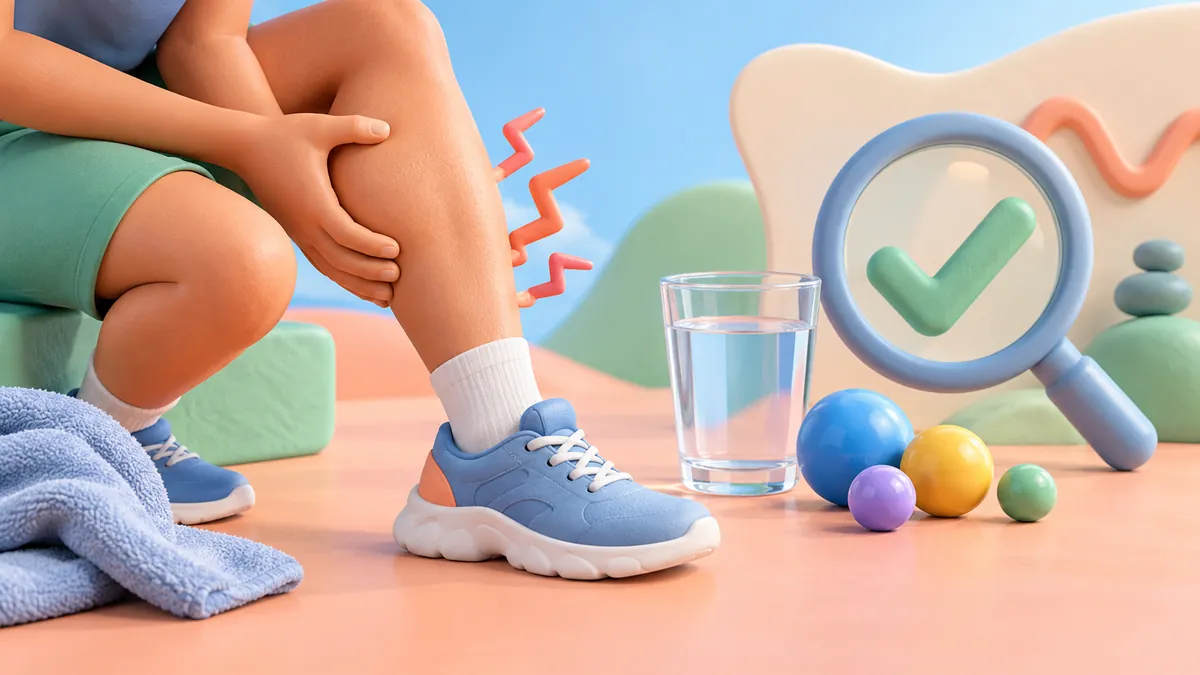
Pickle juice stops a calf cramp in under 90 seconds. That fact built a billion-dollar electrolyte industry — except the cramp ends long before any sodium reaches the bloodstream. The salt story is half the truth at best, and for most workouts it explains almost nothing. This guide walks through what the research actually shows about exercise-associated muscle cramps, when electrolytes do and do not help, and what to reach for when a muscle locks up mid-session.
Quick Answer
The honest summary, before the marketing kicks in:
- For workouts under 60-90 minutes in mild conditions, electrolytes rarely prevent cramps. Neuromuscular fatigue is the more likely driver.
- For long, hot, salty sessions (over 3 hours, heavy sweating, hot or humid weather), sodium becomes legitimately useful.
- Baseline sodium need: roughly 1,500-2,300 mg/day from a normal diet.
- Sweat sodium loss: 300-2,000 mg per liter of sweat — highly individual.
- Magnesium supplements: most controlled trials show no effect on exercise cramps.
If your training stays inside Zone 2 for an hour at a time, water and a balanced diet usually cover it. Check your aerobic ceiling with the Heart Rate Zone Calculator and your long-run effort with the Running Pace Calculator — both help you spot the sessions where electrolyte planning actually earns its keep.
Two Competing Theories of Exercise-Associated Muscle Cramps
The cramp debate has run for nearly a century, and two camps still trade punches.
The dehydration / electrolyte depletion theory is the older one and the one your gym bag has absorbed. The story: heavy sweating drains sodium and other minerals, plasma volume drops, and the disturbed ionic balance triggers involuntary contractions. It is intuitive, it sells drinks, and for decades it was simply assumed.
The altered neuromuscular control theory is the newer model, largely associated with Martin Schwellnus and colleagues. The argument: cramps appear most often in fatigued muscles working through their full range, when the spinal reflex balance shifts — excitatory motor neuron drive rises while inhibitory feedback from Golgi tendon organs drops. The muscle is not running out of salt; its reflex control is misfiring.
Both can be partly right, and the modern picture treats them as overlapping rather than mutually exclusive. But the weight of evidence has clearly drifted toward the neural model for most cramp scenarios.
What the Recent Research Actually Says
Several lines of evidence have eroded the simple "low salt equals cramps" view.
Studies that have measured blood electrolytes in cramping versus non-cramping endurance athletes generally find no meaningful difference in sodium, potassium, magnesium or calcium between the two groups at the moment of cramping. If salt loss were the driver, you would expect a clear signal here — and it is mostly absent.
Cramp-prone athletes also tend to cramp at predictable points: late in a race, on hills, during eccentric loading, or when pushing intensity above what training prepared them for. These are fatigue patterns, not sweating patterns. A swimmer in cool water can cramp without losing meaningful sweat. A lifter can cramp on a heavy set of nordic curls after sipping water all day.
Stretching the cramped muscle reliably ends the spasm within seconds — far faster than any plausible electrolyte mechanism. That alone is a strong hint that the immediate problem is reflex control, not chemistry.
None of this means electrolytes are pointless. It means they are a secondary lever for a specific subset of conditions, not a universal cramp prevention strategy.
When Sodium Actually Matters
There is a real window where sodium intake genuinely earns the marketing budget. Three conditions push you into it:
Long duration. Sessions over 2-3 hours start to deplete sodium meaningfully, especially in a heavy sweater. Marathons, ultras, century rides, full-day hikes — these are the events where deliberate sodium intake during the activity is well supported.
Heat and humidity. Sweat rates climb sharply in hot conditions, and total sodium loss tracks volume. A cool 10K is one situation; a humid 10K in 32°C is another. Above roughly 80°F or 27°C, plan to sip something with electrolytes if the session is long.
"Salty sweaters." Sweat sodium concentration varies from around 300 mg/L on the low end to 2,000 mg/L on the high end. Salty sweaters notice white crust on hats and shirts, sting in their eyes, and a salty taste on the skin. For them, sodium replacement matters earlier than for a light-sweating, low-concentration sibling doing the same workout.
Across these conditions, 300-700 mg of sodium per hour of activity is a defensible band, scaling toward the higher end for heat and known salty sweaters. The dose comes from sports drinks, electrolyte tablets dropped into water, or pinches of salt added to a homemade bottle. The point is not to chase sweat ounce-for-ounce; it is to keep blood sodium in a safe range over many hours.
Magnesium for Cramps: The Persistent Myth
Magnesium is the supplement that refuses to die. Search "muscle cramps" and most of the top hits will recommend a magnesium tablet, often with a brand name attached.
What controlled trials actually find is consistently underwhelming. Studies in adults with exercise-associated muscle cramps, nocturnal leg cramps in older adults, and pregnancy-related cramps have repeatedly shown either no benefit or a tiny effect that does not survive better designs. A pooled view of the trials largely lands on "no convincing effect" for most populations.
That does not mean you should be magnesium-deficient — magnesium has plenty of other jobs, and many people do come up short of the 300-400 mg/day target. Greens, nuts, seeds, beans and whole grains cover it cheaply. But buying magnesium specifically to prevent cramps is, on present evidence, a coin flip at best.
The exception worth flagging: people on diuretics, with gastrointestinal malabsorption, or with documented hypomagnesemia. In those cases the prescribing clinician is already involved, and supplementation has a real target.
Hyponatremia: The Dangerous Flip Side of Over-Hydration
While the cramp-and-salt story is mostly hype, the opposite problem is one of the few hydration issues that actually puts athletes in hospitals.
Exercise-associated hyponatremia happens when you drink so much plain water during a long event that blood sodium drops dangerously low. Early symptoms are nausea, headache, swelling and confusion. Severe cases involve seizures, brain swelling and death. Marathon, ultramarathon and Ironman events have seen real fatalities from over-drinking — almost always in slower finishers who steadily sipped water for many hours without proportional sodium.
The fix is not exotic. Drink to thirst, not to a fixed schedule. Include sodium in your fluids during very long efforts. Be especially careful in cool conditions, where you may feel less thirsty but still drink out of habit. And do not chase a pre-race weigh-in number — finishing slightly lighter is normal and not dangerous in itself.
If you take only one electrolyte lesson from a long-event briefing, it is this: the risk on event day is more often too much water than too little salt.
A Practical Electrolyte Strategy by Activity Type
You do not need a custom protocol; you need a default for each kind of session.
Strength training (45-75 minutes, indoors). Water alone is fine for the session. Eat normally around it — your meals already deliver more than enough sodium. No electrolyte drink required unless you are training in an un-air-conditioned room mid-summer.
Zone 2 cardio (60-90 minutes). Water for the session, food before and after. If you are sweating heavily by minute 60, a pinch of salt in your bottle or a low-sugar electrolyte tablet is reasonable insurance, but most people do not need it. Use the Heart Rate Zone Calculator to confirm you are truly in the lower aerobic band rather than pushing higher and demanding more.
Long runs and rides (90 minutes and over). Now electrolytes earn their place. Aim for 300-500 mg of sodium per hour plus carbohydrates from minute 60 onward. Sports drinks are the simplest delivery; many runners alternate water and electrolyte bottles. Pair this with the Running Pace Calculator to keep your long-run effort honest — pushing too hard on long days raises both cramp risk and fluid demand.
Hot-weather racing or long hikes (over 3 hours, warm conditions). Treat sodium as a daily nutrient, not a single dose. 500-700 mg per hour during the effort, paired with deliberate fluid intake based on your measured sweat rate from the hydration guide. Pre-load with a salty meal the night before; rehydrate with sodium-containing fluids afterward.
For everything else — daily lifting, short runs, classes, casual cycling — the everyday diet covers the electrolyte question. Specialty drinks are convenience, not necessity.
What Actually Helps When You're Cramping Mid-Workout
The moment a muscle locks, theory becomes pointless. You want it gone. What actually works, in roughly the order to try:
Stop the movement and stretch the cramping muscle gently. A calf cramp ends when you straighten the leg and dorsiflex the foot. A hamstring cramp eases as you straighten the knee against the floor. Stretch slowly — do not yank — and hold until the spasm fades.
Reduce intensity for several minutes before resuming. The fatigue model predicts that returning to the same effort that triggered the cramp will trigger it again. Drop a gear, lower the weight, slow the pace, and rebuild.
Light eccentric loading of the affected muscle once the acute spasm passes — slow, controlled movement through range — often discourages recurrence within the same session.
Sip fluid with a little sodium if the session is long, hot or already past the 90-minute mark. This is more about preventing the next cramp during a multi-hour effort than fixing the current one.
Consider pickle juice for stubborn or recurring cramps. The interesting wrinkle here is that pickle juice ends cramps far too fast for sodium absorption to explain it. The leading hypothesis points at TRPV1 and TRPA1 receptors in the mouth and throat — strong-tasting acidic or spicy fluids may trigger a reflex that resets motor neuron firing. Pickle juice, mustard, hot sauce and similar provocations have all been reported to work. Whether this is the right mechanism or not, the empirical result is real, and the dose is small (about 1-2 oz).
Persistent cramps despite all of the above usually means the workout itself is past what your current training supports. Pull back and build the base.
Frequently Asked Questions
Do I need a sports drink for a 45-minute run?
Almost certainly not. Water is fine, and you can rehydrate properly afterward with a normal meal. Sports drinks become genuinely useful past about the 60-90 minute mark or in hot conditions, not for a short morning run in mild weather.
Why does pickle juice work so fast?
The most defensible explanation is a reflex triggered by strong taste receptors in the mouth and throat — not sodium absorption, which would take 15-30 minutes minimum. The cramp ends in under 90 seconds, which only a neural mechanism can explain. Mustard packets work too.
Can I just eat salty food instead of buying electrolyte drinks?
Yes, for most situations. A daily diet that includes some salted food, broths, pickles, cheese, olives or salted nuts covers the 1,500-2,300 mg sodium baseline easily. The specific case for electrolyte drinks is during a long, hot session when you cannot eat a meal — that is where the convenience of a pre-mixed bottle wins.
Are electrolyte tablets worth it?
For long endurance days in heat, yes — they are cheap insurance and convenient. For everyday training under an hour in mild conditions, they are mostly marketing. If you are buying them out of habit rather than session demand, the bottle is doing your wallet more harm than your performance any good.
I get nightly leg cramps. Is that an electrolyte problem?
Probably not. Nocturnal leg cramps are most strongly linked to age, certain medications and prolonged sitting or specific sleep positions. Magnesium has been studied and broadly disappoints. Stretching the calves before bed and reviewing medications with a clinician are higher-yield first steps.
Is "salt-loading" before a long race a good idea?
Modest salt-loading the day before — a salty dinner and adequate fluids — is reasonable for hot, long events. Chugging salt tablets in the final hour before a race is more likely to upset your stomach than help. The safer pattern is normal eating beforehand plus sodium during the event itself.
What about coconut water or "natural" electrolyte drinks?
Coconut water is high in potassium but low in sodium — backwards for endurance fluid replacement, where sodium is the priority. It is a fine beverage; it is not a great long-race fluid unless you also add salt.
The Bottom Line
Cramping is mostly a fatigue and neuromuscular control story, not an electrolyte deficiency. The marketing-friendly version — sweat out salt, replace salt, fix cramp — is too simple to match what the research finds in most situations.
- For short and moderate workouts, water plus a normal diet covers it. Most cramps here trace to fatigue, not chemistry.
- For long, hot or heavy-sweating sessions, deliberate sodium intake (300-700 mg per hour) is genuinely useful, and skipping it is a real mistake.
- Magnesium supplements do not have strong evidence behind them for typical exercise cramps — fix dietary intake instead.
- Hyponatremia from over-drinking is the more dangerous and underrated problem in endurance events.
- Mid-cramp, stretch and reduce intensity first. Pickle juice is a legitimate emergency tool when nothing else is working.
Treat electrolyte strategy as a tool you bring out for specific sessions, not a daily ritual you owe a beverage brand. Most of your training will not need it; the sessions that do, will reward planning.
Persistent or severe cramps can signal medical issues such as nerve compression, thyroid or kidney problems, or medication side effects; consult a healthcare provider if symptoms continue.