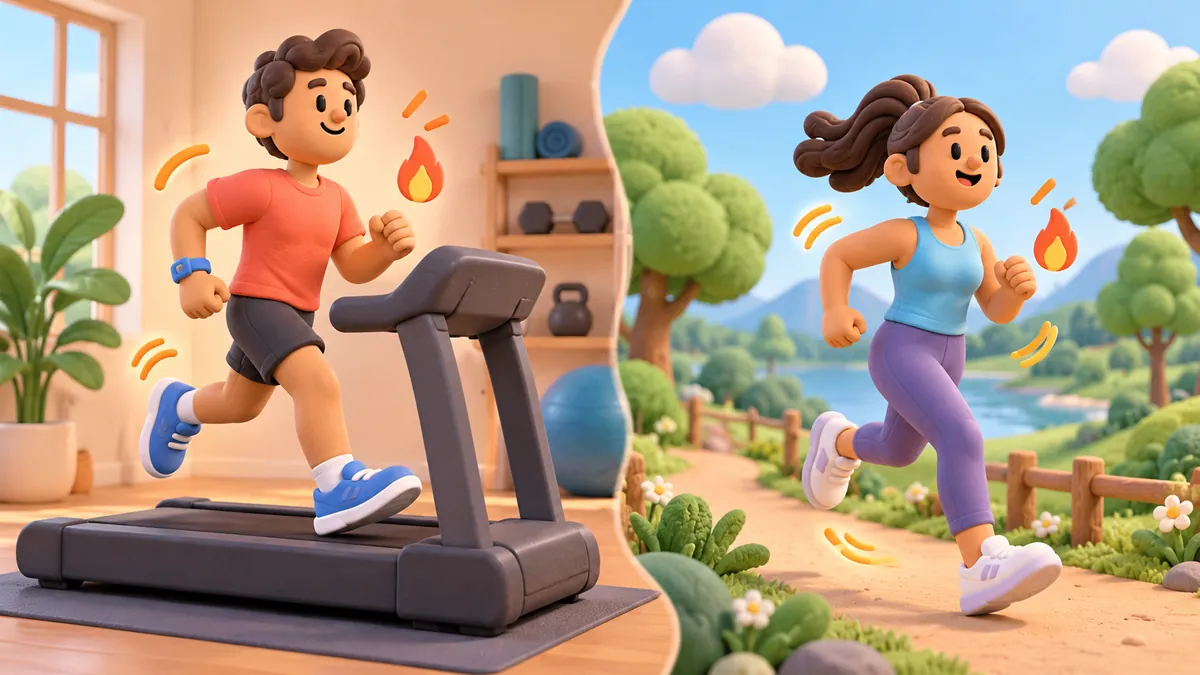
A 10-kilometre run on the treadmill and a 10-kilometre run outdoors don't burn the same calories — but the gap is smaller than fitness folklore suggests. This guide breaks down where the calorie difference comes from, how to match the two for fair comparison, and which to pick when training for an outdoor race.
Quick Answer
- Per kilometre at the same pace, outdoor running burns 5–7% more calories than treadmill running, mostly due to wind resistance and uneven terrain.
- Setting the treadmill to 1% incline closes most of the gap for paces above ~8 km/h.
- For calorie tracking, treat them as roughly equivalent if you use a 1% incline; otherwise subtract ~5% from treadmill estimates.
- For race preparation, outdoor running still wins on neuromuscular and tactile specificity.
Track your pace and predicted calorie expenditure with our Running Pace Calculator and TDEE Calculator.
Where Outdoor Burns More
Three physiological reasons outdoor running costs slightly more per kilometre:
- Wind resistance. Even with no perceived wind, you're pushing through still air. At ~12 km/h, air drag adds roughly 2–7% to the energy cost.
- Surface variation. Subtle camber, gravel, grass, road texture — your stabilisers fire more. Treadmill belts are smooth and predictable.
- Stride micro-corrections. Outdoors, every step is slightly different. The body compensates constantly; that compensation isn't free.
Combined, the gap totals 5–7% at typical training paces in flat, calm conditions.
Why the 1% Incline Rule Exists
A widely cited study (Jones & Doust, 1996) showed that at speeds 8 km/h and above, a 1% treadmill incline roughly matches the metabolic cost of outdoor running on flat ground.
Below 8 km/h (slow walking pace), the air-resistance effect is small and 1% incline is unnecessary.
Above 12 km/h, even 1% incline slightly under-estimates outdoor — but the gap is small.
For most recreational runners at 5:00–6:30 /km, 1% incline is the honest match.
Worked Example
A 70 kg runner doing 10 km in 50 minutes (5:00/km, 12 km/h):
| Setting | Energy cost (kcal) | |---|---| | Outdoor, flat | ~720 | | Treadmill, 0% incline | ~680 | | Treadmill, 1% incline | ~715 |
Difference between outdoor and 0% treadmill at the same pace: about 40 kcal for a 10 km run. Small enough to ignore for one session, big enough to matter over weeks if you don't correct.
Where Treadmills Win
The treadmill is not just "outdoor running indoors." It has real strengths:
- Pace control. Easy days stay easy. No urge to chase the watch.
- Weather independence. Heat, cold, ice, hail, traffic — gone.
- Joint cushioning. Modern treadmills are softer than concrete.
- Specific interval pacing. Easier to hold exact target paces, especially for VO₂max work.
- Hill simulation without hills. Programmed inclines reproduce climbs that aren't local.
For some sessions, the treadmill is better than outdoors.
Where Outdoor Wins
- Race specificity. Race day is outdoors. Tactile, neurological and breathing patterns shift slightly.
- Variable surfaces and grades that train ankles, hips and small stabilisers.
- Mental training. Outdoor pacing without belt assistance is a separate skill.
- Cooling efficiency. Air movement (and ambient temp on a normal day) usually cools better than gym ventilation.
For race prep — particularly any race over 10 km — at least 60–80% of weekly mileage outdoors is wise.
Biomechanics: What the Belt Changes
The bigger differences between treadmill and outdoor running are not calorie-counted at all — they're in how your body moves:
- Stride length usually shortens by 2–4 cm on a treadmill because the belt pulls the leg under you. Some runners over-stride outdoors to "match" race pace and end up over-loading the knees.
- Cadence rises slightly on the treadmill for most runners. That's usually a good thing — higher cadence with the same pace tends to be more efficient.
- Vertical oscillation drops on the belt. The smoother surface invites a flatter foot path.
- Glute activation is lower outdoors than indoors at matched pace, because the belt does part of the leg-recovery work. Heavy treadmill use without outdoor running can quietly weaken the posterior chain over months.
For runners doing 80%+ of mileage on the treadmill, two outdoor runs per week restore the missing glute and stabiliser work without major schedule disruption.
Calorie Tracking: Practical Adjustments
For someone logging calories carefully:
| Run | Adjustment | |---|---| | Treadmill 0% incline | Subtract ~5% from displayed/estimated calories | | Treadmill 1% incline | Use as-is (matches outdoor well) | | Treadmill 2%+ incline | Treadmill estimate often slightly over vs. flat outdoor | | Outdoor, calm conditions | Use the standard pace × weight estimate | | Outdoor, strong headwind | Add 3–8% (significant wind only) |
For most fitness goals, ±5% calorie accuracy doesn't change outcomes. Focus on the trend, not the per-session number.
Heat, Cold, and Calorie Reality
The "fair comparison" only holds in neutral conditions. Real outdoor running often deviates sharply:
- Cold weather (under 5 °C) raises calorie burn by 3–8% through thermogenesis, especially in the first 15 minutes before you warm up. Add another small bump for fighting wind chill on a windy day.
- Heat above 25 °C increases heart rate at the same pace, but actual calorie burn rises only slightly (~2–3%). What people perceive as "burning more in the heat" is mostly perceived effort, not energy cost.
- Humidity is the underrated variable. At 80%+ humidity, perceived effort jumps but calorie burn barely moves; pace drops because the body cannot dump heat.
- Altitude above ~1,500 m raises calorie burn at any given pace by 5–10% as the body recruits more anaerobic energy. Useful to know — and a reason mountain runners under-eat in the first week of camp.
The treadmill removes all of these. That's a feature for honest pacing, and a bug for the kind of resilience that outdoor race courses demand.
Common Mistakes
- Treating "12 km/h on the treadmill" and "12 km/h outdoors" as identical workouts. They're close but not equal.
- Using treadmill 0% incline year-round. A 1% incline costs almost nothing and matches outdoor more honestly.
- Doing every long run on the treadmill before a road race. Specificity matters; race day is outdoor.
- Trusting treadmill calorie displays as truth. Built-in calorie estimates often overstate by 15–30%.
Pace Conversion Treadmill ↔ Outdoor
Pace itself is the same number (km/h or mph) on either surface. What changes is the metabolic cost at that pace. Practical rules of thumb:
- A "comfortable" outdoor 5:00 /km might feel like a "comfortable" treadmill 5:05 /km on a 1% incline.
- Race-pace simulation: treadmill +1% incline at goal race pace is a fair approximation.
- For interval pace, use the same numerical pace — the treadmill simply removes the variability.
Tempo Sessions: Indoor or Outdoor?
A clean way to plan:
- Easy runs → outdoor whenever weather allows; treadmill if it forces honest easy pacing.
- Intervals → treadmill works very well; controlled pacing.
- Tempo / threshold → outdoor builds race-day rhythm; treadmill gives clean control.
- Long runs → outdoor 80%+ of the time, especially in marathon prep.
Frequently Asked Questions
Are treadmills less effective for fat loss?
No. Calorie expenditure is similar at matched effort and 1% incline. Treadmills can actually help adherence — no weather excuses.
Does treadmill running hurt my knees less?
Cushioning is softer than concrete. Some runners with mild patellar irritation feel better on a treadmill; some feel worse because the locked stride loads the same tissues repeatedly. Vary surfaces if you're prone to overuse.
What about elliptical or rowing — same calorie burn?
Rough equivalence depends on heart-rate effort. Running tends to top out highest per minute at hard intensities, with rowing and elliptical close behind for fit athletes.
Should I set the treadmill to 0% or 1%?
1% incline is the simplest match for outdoor running at common training paces.
How accurate are wearables' running calorie estimates?
For running, typically within ±10–15% when GPS pace data is included. Less accurate when relying solely on heart rate, especially on a treadmill (no GPS distance, just speed input).
Bottom Line
Treadmill and outdoor running are near-equivalent training tools at the calorie level:
- Use 1% incline on the treadmill to match outdoor energy cost.
- Track pace and calorie estimates with our Running Pace Calculator and TDEE Calculator.
- 80%+ of long runs outdoors when training for an outdoor race.
- Treadmill for intervals when precision pacing matters.
- Don't sweat the ±5% calorie gap for general fitness — it's smaller than tracking error.
Pick the surface that lets you train consistently. The body responds to volume more than venue.
Health and fitness calculations are estimates only and not medical advice. Anyone returning to running, or with knee/back history, should ramp distance gradually regardless of surface.