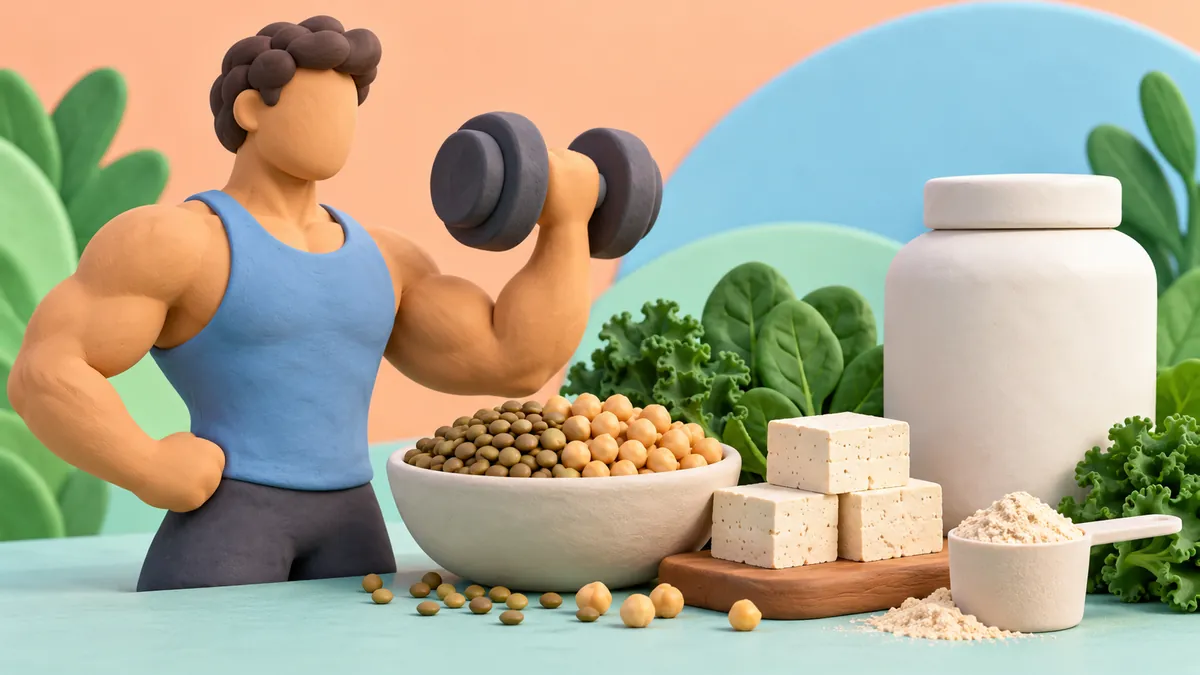
For decades, the standard advice was that plant-based lifters would always trail their omnivore peers — lower DIAAS scores, sparse leucine, and the dreaded methionine gap in beans. That story is no longer accurate. A 2021 randomized trial in young men following a fully vegan diet built the same amount of muscle as their omnivore counterparts when total protein was matched at roughly 1.6 g/kg over twelve weeks of hard training. Several smaller studies have landed in the same place. The conclusion is not that plant protein equals animal protein gram-for-gram — DIAAS still says it does not — but that the gap is closable with intentional planning.
Quick Answer
- Plant protein can build muscle equally well, but only when total intake is slightly higher and meals are designed around the leucine threshold.
- Target 1.8 to 2.4 g of protein per kg of body weight — about 15 to 20 percent higher than the typical omnivore range of 1.6 to 2.2 g/kg.
- Anchor each meal around 2.5 to 3 g of leucine, which usually means 35 to 45 g of plant protein from a soy, pea, or blended source.
- Take creatine (5 g/day), vitamin B12 (250 mcg/day), vitamin D, and algae-based omega-3 as non-negotiables. Iron, zinc, and iodine deserve a closer look.
- Run your daily numbers through the Macro Calculator and verify energy needs with the Calorie Calculator.
Quick comparison of plant vs animal protein quality:
| Metric | Animal protein | Plant protein | |---|---|---| | DIAAS (typical range) | 90 to 120 | 60 to 95 | | Leucine per 30 g serving | 2.4 to 3.4 g | 1.6 to 2.5 g | | Digestibility (small intestine) | 90 to 98 percent | 70 to 90 percent | | Cost per gram of usable protein | Moderate to high | Low to moderate | | Fiber and phytonutrient bonus | None | Substantial |
Why Plant Protein Was Considered Inferior
The historical case against plant protein rested on three real biochemical facts.
Lower DIAAS scores. The Digestible Indispensable Amino Acid Score measures how much of each essential amino acid your small intestine actually absorbs. Whey isolate scores around 100 to 110, milk near 115, and beef around 95. Soy isolate lands at 85 to 95, pea isolate at 80 to 90, and rice or wheat protein in the 40 to 70 range. On paper, a gram of soy delivers fewer usable amino acids than a gram of whey.
The methionine and lysine gaps. Most legumes (beans, lentils, peas, soy) are low in methionine. Most grains (rice, wheat, oats, corn) are low in lysine. Eat only one family and you run short on one essential amino acid; the body cannot store amino acids and uses the limiting one as a ceiling on protein synthesis.
Leucine concentration. Leucine is the amino acid that flips the switch on muscle protein synthesis. Animal proteins typically carry 9 to 11 percent leucine by weight, while most plant proteins sit at 6 to 8 percent. To deliver the same leucine dose, you need a larger serving of plant protein.
These differences are real. What changed is the recognition that they are addressable, not insurmountable.
What Recent Research Actually Shows
The 2021 randomized trial that shifted the conversation followed two groups of resistance-trained young men over twelve weeks. One group ate animal protein; the other ate exclusively plant protein, with soy as the main source. Both groups were matched at roughly 1.6 g of protein per kg of body weight. Muscle thickness, lean mass gains, and strength all increased similarly between groups, with no meaningful difference.
Several follow-up studies replicated the pattern: when total protein is sufficient and well-distributed, the source becomes a secondary variable. A separate line of research on older adults shows the gap reappears at lower intakes or when relying on lower-DIAAS sources alone, which is consistent with the leucine threshold model.
The takeaway is not "plant equals animal in every condition." It is that at sensible total intakes with thoughtful source selection, plant-based lifters build muscle at the same rate. For a deeper dive into how quality and quantity interact, see protein quality versus quantity.
The Practical Plant Protein Targets
The most useful adjustment a vegan lifter can make is bumping the total target up by about 15 to 20 percent compared with the omnivore baseline. The reasoning is straightforward: lower DIAAS means a smaller fraction of each gram becomes usable amino acids, and the leucine fraction per gram is lower.
For most vegan lifters in a maintenance or gaining phase, the workable range is 1.8 to 2.4 g of protein per kg of body weight. During an aggressive cut, the upper end (2.2 to 2.6 g/kg) protects muscle better.
To clear the leucine threshold of 2.5 to 3 g per meal, here is what each plant source needs to look like at the plate:
| Plant source | Serving for 2.5 g leucine | Total protein in that serving | |---|---|---| | Soy isolate powder | About 30 g powder | 25 g protein | | Pea isolate powder | About 35 g powder | 28 g protein | | Firm tofu | 220 to 250 g | 30 to 35 g protein | | Tempeh | 180 to 200 g | 35 to 38 g protein | | Seitan | 150 g | 35 to 40 g protein | | Cooked lentils | 380 to 450 g | 28 to 32 g protein | | Edamame (shelled, cooked) | 280 g | 32 g protein | | Black beans (cooked) | 450 g | 30 g protein |
The pattern is clear: soy products, seitan, and pea-based powders carry their weight in one serving, while a beans-only or lentils-only meal needs a notably larger portion to clear the leucine line.
Best Plant Protein Sources by DIAAS
Not all plant proteins are created equal. Anchoring meals around the higher-DIAAS sources reduces the need to over-eat total grams.
| Source | DIAAS (approx) | Leucine per 30 g protein | Notes | |---|---|---|---| | Soy isolate | 85 to 95 | 2.2 to 2.5 g | Best single-source plant powder; complete amino profile | | Tempeh | 80 to 90 | 2.0 to 2.4 g | Fermented soy; better digestibility than tofu | | Tofu (firm) | 75 to 85 | 1.9 to 2.3 g | Versatile, mild flavor | | Pea isolate | 80 to 90 | 2.0 to 2.3 g | Best non-soy powder; low in methionine | | Pea plus rice blend | 90 to 100 | 2.2 to 2.5 g | Combination covers both methionine and lysine gaps | | Seitan (wheat gluten) | 50 to 60 | 1.8 to 2.0 g | High in protein per gram; low in lysine — never use alone | | Lentils | 60 to 70 | 1.6 to 1.9 g | Good fiber bonus; needs grain pairing | | Chickpeas | 55 to 65 | 1.6 to 1.8 g | Same blending logic as lentils | | Hemp seeds | 60 to 70 | 1.7 to 2.0 g | Complete profile but lower density | | Quinoa | 70 to 80 | 1.7 to 2.0 g | Complete in one food, moderate density |
If a meal is built around soy, tempeh, seitan-plus-legume, or a pea-rice blend, amino acid quality is essentially handled in that single meal. Lower-DIAAS sources work, they just need either a larger portion or a complementary partner on the same plate.
Combining Proteins to Close Amino Acid Gaps
The old "complete vs incomplete" framing on nutrition labels was always too strict. Every plant food contains every essential amino acid; some just have less of one or two. The fix is not exotic — eat two plant families across the same day and the gaps cancel.
Classic pairings:
- Rice and beans. Rice provides methionine, beans provide lysine, and the combined profile is roughly equivalent to a complete protein.
- Pea plus rice powder. The same logic in a shake. DIAAS climbs from about 80 to 90 alone to roughly 95 to 100 when paired.
- Tofu and brown rice. Soy is complete on its own; the rice adds carbs and a small lysine bonus.
- Peanut butter on whole-grain bread. A surprisingly effective snack pairing — legume plus grain.
- Hummus and pita. Chickpeas plus wheat covers both limiting amino acids.
You do not need to pair proteins within the same meal as long as you pair them across the day. The amino acid pool in your bloodstream draws from everything eaten in a roughly 24-hour window.
Essential Supplements for Vegan Lifters
Some supplements are nice-to-have. Others are non-negotiable for plant-based lifters. The list below is ordered by how strongly the evidence supports it.
Creatine monohydrate (5 g/day) — critical. Creatine is found almost exclusively in animal muscle. Vegans typically have lower baseline muscle creatine stores than omnivores, which actually means the performance and muscle-building benefit of supplementation is larger for plant-based lifters. A flat 5 g per day saturates stores within about a month. The supplement is synthesized chemically, not derived from animals, so it fits any vegan protocol. For the full mechanics, see creatine loading versus maintenance.
Vitamin B12 (250 mcg/day, or 2,500 mcg/week) — mandatory. B12 is produced by bacteria and is essentially absent from plant foods. Deficiency causes anemia, neurological symptoms, and impaired recovery. Every vegan should supplement B12, regardless of training status.
Vitamin D (1,000 to 2,000 IU/day, vegan D3 from lichen). Most adults — vegan or not — fall short on vitamin D outside of summer months, especially at higher latitudes. Look for D3 sourced from lichen rather than the more common lanolin-derived form.
Omega-3 from algae oil (250 to 500 mg combined EPA plus DHA/day). Plant sources like flax, chia, and walnuts provide ALA, but conversion to EPA and DHA is poor (around 5 to 10 percent for EPA, less for DHA). Algae oil delivers EPA and DHA directly and is the only fully vegan source.
Iron — monitor first, supplement if needed. Plant iron (non-heme) is absorbed less efficiently than animal iron. Pairing iron-rich foods with vitamin C improves absorption. Get blood work before supplementing — excess iron is harmful.
Zinc, iodine, calcium. Zinc absorption from plant foods is reduced by phytates; a low-dose 8 to 15 mg supplement is reasonable if intake is borderline. Iodine at 150 mcg/day is covered by iodized salt or one sheet of nori. Calcium should hit 700 to 1,000 mg/day from fortified plant milks, calcium-set tofu, leafy greens, and tahini.
A Sample Day of Vegan Bodybuilding Macros
A 75 kg male lifter in a slight surplus, targeting 2,800 kcal and 160 g of protein (about 2.1 g/kg):
Breakfast (7 a.m.) — 35 g protein
- 250 g firm tofu scramble with spinach and nutritional yeast
- 2 slices whole-grain toast
- 1 cup fortified soy milk
- Leucine estimate: 2.8 g
Pre-workout snack (10:30 a.m.) — 15 g protein
- 30 g pea-and-rice protein blend in water
- 1 banana
- Leucine estimate: 1.2 g (sub-threshold by design — small bridge meal)
Post-workout lunch (1 p.m.) — 40 g protein
- 150 g seitan stir-fry
- 1 cup cooked brown rice
- 100 g edamame
- Mixed vegetables in sesame-soy sauce
- Leucine estimate: 3.4 g
Afternoon snack (4 p.m.) — 25 g protein
- 30 g soy isolate powder
- 250 g soy yogurt
- 30 g almonds
- Leucine estimate: 2.6 g
Dinner (7:30 p.m.) — 45 g protein
- 200 g tempeh marinated and pan-seared
- 1 cup cooked lentils
- Roasted vegetables
- 1 small whole-grain roll
- Leucine estimate: 3.2 g
Four out of five meals clear the leucine threshold cleanly. The mid-morning bridge meal is intentionally lighter — total daily protein still lands at 160 g, and the meals around training do the heavy lifting for muscle protein synthesis. For omnivore-style targets and reasoning on intake, the protein intake guide walks through the underlying math.
Common Mistakes Vegan Lifters Make
Under-eating total calories. Plant foods are bulkier and lower in calorie density. Hitting 3,000 kcal on a vegan diet takes more food volume than on a mixed diet. Many vegan lifters who plateau are simply not eating enough — verify with the Calorie Calculator before blaming protein quality.
Relying on a single protein source. Eating only lentils, only tofu, or only one powder will technically deliver enough total protein but produces lopsided amino acid profiles meal-to-meal. Rotate across soy, pea, legumes, grains, and seitan.
Ignoring B12 supplementation. B12 deficiency develops slowly — sometimes over years — and the early symptoms (fatigue, brain fog, weak recovery) get blamed on training stress. Supplement from day one of going vegan.
Skipping creatine because it sounds animal-derived. Modern creatine monohydrate is synthesized chemically. The marginal performance gain (around 5 to 10 percent on strength and around 1 to 2 kg of additional lean mass over months) is too large to leave on the table.
Treating "plant-based" as automatically healthy. Vegan junk food exists — refined carbs, oils, and processed mock meats can crowd out the whole foods that carry the amino acid and micronutrient load.
Under-dosing leucine in any single meal. A salad with a small handful of chickpeas might be a nice lunch, but it will not trigger meaningful muscle protein synthesis. Anchor every meal with a higher-DIAAS source or a larger portion of lower-DIAAS food.
Frequently Asked Questions
Is soy bad for testosterone?
No. The concern comes from isoflavones, which are phytoestrogens — plant compounds with weak estrogen-like effects. Multiple meta-analyses in men show no measurable impact on testosterone or estrogen levels at normal dietary intakes, even at fairly high soy consumption (multiple servings per day). Soy remains one of the best plant protein sources for resistance-trained athletes.
Do I need to combine proteins at every meal?
No. The "complementary proteins must be combined at the same meal" idea was retracted decades ago. Your body draws amino acids from foods eaten across roughly a 24-hour window. As long as your day includes both legumes and grains (and ideally some soy or pea-based protein), amino acid completeness is handled.
Can I build muscle on rice and beans alone?
In principle yes — rice and beans together cover the essential amino acids. In practice it is impractical at high protein targets. Getting 160 g of protein from rice and beans alone requires roughly 1,400 to 1,700 g of cooked food, well above 3,000 kcal of mostly carbs. Use rice and beans as a foundation, but include soy products, seitan, and a quality protein powder to fit the macros without bloating.
Is pea protein as effective as whey?
Close, but not identical gram-for-gram. Pea isolate has a DIAAS of about 80 to 90 versus whey's 100 to 110, and leucine per 30 g is about 2.0 to 2.3 g versus whey's 3.0 to 3.4 g. A pea-and-rice blend at 35 to 40 g of powder closes most of the gap on a single shake. For total daily intake within the recommended range, the muscle-building outcome is essentially the same.
Do I really need higher protein than omnivores?
Yes, modestly. The 15 to 20 percent uplift compensates for lower DIAAS and lower per-gram leucine. If you train hard and want to optimize hypertrophy, 1.8 to 2.4 g/kg is the working range. Athletes who match the omnivore range of 1.6 g/kg can still gain, but the margin for error in meal planning is smaller.
Can I skip protein powder if I eat enough whole foods?
Yes, but it is a logistical challenge at high targets. Hitting 180 g of protein from whole vegan foods alone takes careful planning around tofu, tempeh, seitan, lentils, beans, and nuts. A single 30 g scoop of soy or pea-rice blend is the simplest way to add 25 to 28 g of high-quality protein without volume.
Are amino acid supplements (EAAs, BCAAs) useful?
For most vegan lifters hitting their daily target, no. Whole-food plant proteins and quality powders already contain all the essential amino acids. BCAA-only products are explicitly not worth taking — they cover only 3 of the 9 essential amino acids and can compete with other aminos for transport.
The Bottom Line
Plant-based bodybuilding is no longer a compromise. Recent randomized trials confirm what experienced vegan lifters have known for years: with intentional planning, plant protein builds muscle equally well. The protocol is just slightly more deliberate. Push your total protein 15 to 20 percent higher than the omnivore baseline, anchor each meal with a higher-DIAAS source like soy, tempeh, seitan, or a pea-rice blend, and clear the 2.5 to 3 g leucine threshold per meal. Take creatine and B12 without exception, and round out with vitamin D, algae omega-3, and the trace minerals that plant diets tend to miss.
The bodybuilders winning vegan competitions are not gifted with special genetics. They are people who learned the math, set up a meal pattern, and ran it for years.
Consult a healthcare provider or registered dietitian before making major dietary changes, especially if you have existing nutritional deficiencies.