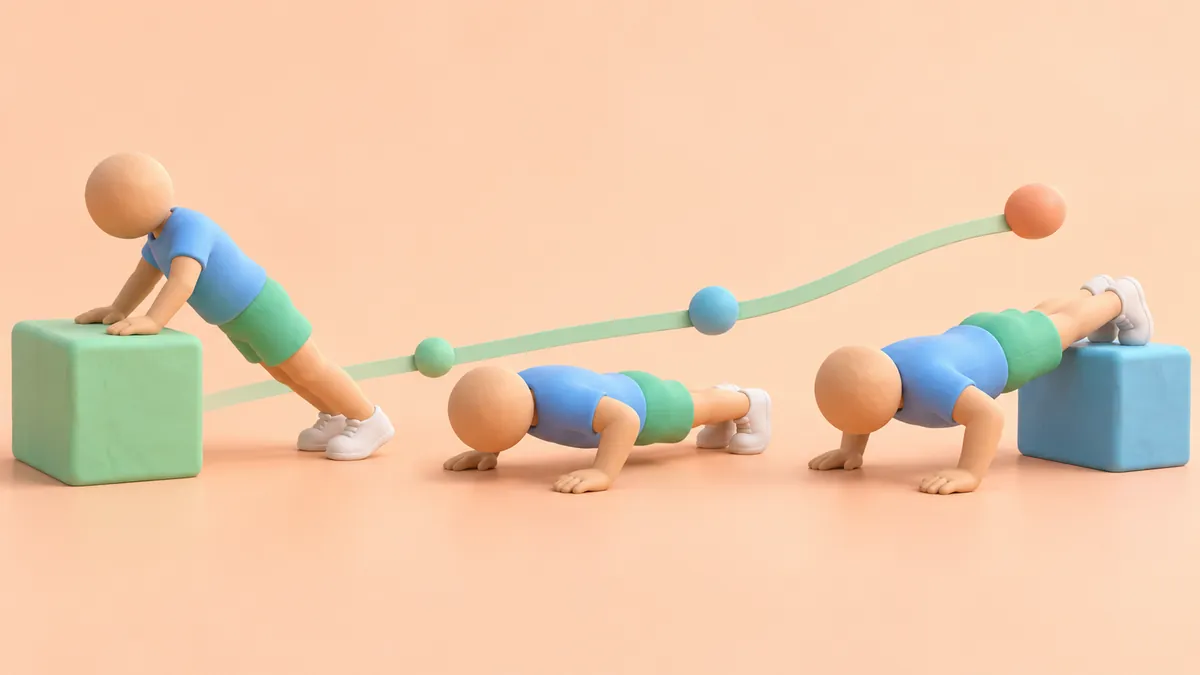
"You can't make gains without a gym." It's the most common excuse for stalling on bodyweight training, and it's wrong. Progressive overload is a principle — do more work over time — and load is only one of eight or nine ways to add work. If you can't add plates, you can add reps, sets, tempo, range of motion, mechanical disadvantage, density, frequency, instability, or explosiveness. Used in the right order, those levers will keep you progressing for years on nothing but your bodyweight and a pull-up bar.
Quick Answer
| Lever | What you change | When to use it | |---|---|---| | Reps | more reps per set | early stages, learning a movement | | Sets | more total sets per session | once your reps stall at the top of a range | | Tempo | slow eccentrics, isometric pauses | when reps and sets feel "free" but you can't add load | | Range of motion | deeper dip, elevated hands | to make a movement harder without changing the pattern | | Leverage | feet elevated, archer, lever shifts | when standard form is too easy for the rep range | | Density | shorter rest, EMOM, circuits | conditioning and time efficiency phases | | Frequency | more sessions per week | when recovery allows and skill needs reps | | Unilateral | one-leg or one-arm variants | the cleanest path from "easy" to "very hard" | | Plyometric | explosive variants | power and athleticism, not main hypertrophy driver |
Bottom line: rotate these levers in the order above. Add reps until you hit the top of a range, then add sets, then slow the tempo, then change the leverage or move to a harder variant. You can get from knee pushups to one-arm pushups with no equipment beyond a floor.
Why Progressive Overload Is About Stimulus, Not Plates
The body adapts to a stimulus that exceeds what it's used to handling. A barbell adds stimulus by adding weight. Bodyweight training adds stimulus by changing almost everything else — and the underlying muscle, tendon, and nervous-system adaptation is the same.
If you train a movement the same way for months — same reps, same sets, same tempo, same variation — you stop adapting. The fix isn't necessarily heavier load. It's any change that forces the muscles to produce more force, for longer, or in a less mechanically favorable position than they're used to.
That definition opens up a long list of progression levers. Most lifters never use more than two of them. The rest of this guide walks through all nine in the order you should typically reach for them.
Lever 1: Reps (Volume Increase)
The simplest lever. If you can do 10 pushups today, do 11 next session, then 12. Total reps go up, total work goes up, stimulus goes up.
Use rep ranges with a top and bottom: for hypertrophy, 8 to 15 reps per set works well on most pushing and pulling movements. Add one rep per set when you hit a good session. When you can hit the top of the range for every set with clean form for two or three sessions in a row, you've earned the next lever.
Reps are where every beginner should start. They are also where most people stop, which is why progress stalls after the first three months.
Lever 2: Sets (More Volume)
Once you can hit the top of your rep range on every set, add a set.
Going from 3 sets of 15 pushups to 4 sets of 15 is a 33 percent jump in total volume — that's a real progression. You'll often need to drop reps by one or two on the new set count for a session or two while you adapt, then build back up.
Volume is the most reliable hypertrophy driver in the research. For bodyweight training, set count is where most of your volume control lives. Plan it deliberately rather than just "doing pushups until you're tired."
Lever 3: Tempo
Tempo is the most underused lever in bodyweight training. The same exercise can become two or three times harder without any change to leverage or range — just by slowing it down or pausing it.
Three tempo manipulations to know:
- Slow eccentrics. Take 3 to 5 seconds to lower into a pushup or pull-up. The eccentric phase produces high mechanical tension and is one of the strongest hypertrophy stimuli available.
- Isometric pauses. Hold the bottom of a squat or pushup for 2 to 3 seconds before pressing up. Pauses kill the stretch reflex and force the muscles to start the lift from a dead position.
- Slow concentric. Press up slowly and under control. Less productive than slow eccentrics, but useful for grooving a movement pattern.
A pushup at a 4-1-1-0 tempo (4 seconds down, 1 second pause, 1 second up, 0 pause at top) is a different exercise than a fast bouncy pushup, even though the rep count is identical. Tempo lets you keep "the same movement" on your program for months while still progressing.
Lever 4: Range of Motion
Most people shorten their range over time without realizing it. Reversing that — deliberately adding range — is a free progression.
Examples:
- Deficit pushups. Place your hands on two parallettes or books so your chest can drop below your hand level. The added few inches of stretch at the bottom dramatically increase chest and shoulder demand.
- Deep split squats. Lower until your back knee taps the floor and your front thigh is well past parallel.
- Full hang to chin over bar. A pull-up that starts in a dead hang and finishes with your collarbone at the bar is much harder than a half-rep.
- Ass-to-grass squats. Going all the way down and bouncing out of the bottom recruits more glute and adductor work than a partial squat.
Extending range is usually free in the sense that it requires no new equipment. It does require honesty about where your current "rep" actually starts and ends.
Lever 5: Leverage (Mechanical Disadvantage)
This is where bodyweight training becomes nearly limitless. Change your body's leverage and the same muscles work against effectively much greater resistance.
Pushup leverage shifts, from easiest to hardest:
- Hands on a wall (most upright, easiest)
- Hands on a kitchen counter
- Hands on a chair
- Standard floor pushup
- Feet on a chair (decline pushup)
- Feet on a tall box
- Archer pushup (one arm extended, most weight on the working side)
- One-arm pushup
Each step shifts more of your bodyweight onto the working muscles, even though your actual mass hasn't changed. The leverage lever is the rough equivalent of adding plates to a barbell — except the increments are larger and you can't load it as precisely.
Pull-up leverage shifts work similarly: archer pull-ups, typewriter pull-ups, and finally one-arm work.
Lever 6: Density (Less Rest, Same Work)
Density means doing the same amount of work in less time. The session gets harder without changing what's on paper.
Two ways to manipulate it:
- Cut rest periods. If you normally rest 2 minutes between pushup sets, drop it to 90 seconds, then 60.
- EMOM (every minute on the minute). Set a timer. At the top of each minute, do a set of 8 pushups. Whatever's left of the minute is your rest. As you fatigue, rest shrinks automatically.
Density progression is excellent for conditioning and time efficiency, but it competes with strength progression — you can't both lift heavier (or harder leverage) and shorten rest at the same time. Pick one focus per training block. For pure strength on a bodyweight ladder, rest a full 2 to 3 minutes between hard sets.
Lever 7: Frequency
Doing pushups twice a week and progressing well? Try three times a week and see if you progress faster.
Bodyweight movements typically recover faster than heavy barbell lifts because peak loads are lower per rep. That means you can usually train them 3 to 5 times per week without overtraining, especially if you're rotating variations.
A simple frequency upgrade: take a movement you currently train twice a week, add a third easier session in the middle (lower reps, easier variation, or just movement practice). Skill movements like one-arm pushups and pistol squats reward higher frequency more than max-effort barbell lifts do, because the neural skill component is large.
Lever 8: Unilateral Variants
The cleanest, most reliable bodyweight progression path is "two limbs to one limb." Doubling the load on one side of the body produces a roughly twofold strength demand, with extra balance and stability requirements on top.
The unilateral path on the major movement patterns:
| Movement | Two-limb start | Unilateral target | |---|---|---| | Press | standard pushup | one-arm pushup | | Squat | bodyweight squat | pistol squat | | Pull | pull-up | one-arm pull-up (very advanced) | | Hinge | glute bridge | single-leg glute bridge, then Nordic curl | | Row | inverted row | archer row, then one-arm row |
The middle ground (archer variations, assisted single-limb work) gives you a smooth ramp from two-limb to one-limb. You rarely need any equipment.
Lever 9: Plyometric and Explosive Variants
Adding speed and explosiveness is the last lever. Clap pushups, plyo pull-ups, jump squats, and box jumps all add force-production demand by requiring rapid concentric effort.
Plyometrics are excellent for power and athletic carryover, but they are a poor primary driver of muscle growth. Treat them as a supplement to the rest of your program, not a replacement. They also place high demand on tendons and joints, so build a foundation of strength before piling on plyo volume.
Progression Ladders for the Main Movements
The cleanest way to plan bodyweight progression is to write out a ladder for each movement and climb it. Here are practical ladders for the major patterns.
Pushup Ladder
| Step | Variation | Target before progressing | |---|---|---| | 1 | Wall pushup | 3 sets of 20 | | 2 | Incline pushup (counter) | 3 sets of 15 | | 3 | Knee pushup | 3 sets of 15 | | 4 | Standard pushup | 3 sets of 15 | | 5 | Deficit pushup (hands elevated) | 3 sets of 12 | | 6 | Decline pushup (feet elevated) | 3 sets of 12 | | 7 | Archer pushup | 3 sets of 6 per side | | 8 | One-arm pushup (assisted) | 3 sets of 5 per side | | 9 | One-arm pushup (strict) | 3 sets of 5 per side |
Pull-up Ladder
| Step | Variation | Target before progressing | |---|---|---| | 1 | Dead hang | 3 sets of 30 seconds | | 2 | Scapular pull (active hang) | 3 sets of 10 | | 3 | Negative pull-up (5-second descent) | 3 sets of 5 | | 4 | Band-assisted pull-up | 3 sets of 8 | | 5 | Strict pull-up | 3 sets of 8 | | 6 | L-sit pull-up | 3 sets of 5 | | 7 | Archer pull-up | 3 sets of 3 per side | | 8 | Weighted pull-up or one-arm progressions | individual |
Squat Ladder
| Step | Variation | Target before progressing | |---|---|---| | 1 | Box squat (sit to a chair) | 3 sets of 20 | | 2 | Bodyweight squat | 3 sets of 25 | | 3 | Split squat | 3 sets of 12 per leg | | 4 | Bulgarian split squat (rear foot elevated) | 3 sets of 10 per leg | | 5 | Assisted pistol (hold a doorframe) | 3 sets of 5 per leg | | 6 | Box pistol (sit and stand from a box) | 3 sets of 5 per leg | | 7 | Full pistol squat | 3 sets of 5 per leg | | 8 | Shrimp squat | 3 sets of 3 per leg |
Hinge Ladder
| Step | Variation | Target before progressing | |---|---|---| | 1 | Glute bridge | 3 sets of 20 | | 2 | Single-leg glute bridge | 3 sets of 12 per leg | | 3 | Hip hinge pattern with light backpack | 3 sets of 15 | | 4 | Single-leg Romanian deadlift | 3 sets of 10 per leg | | 5 | Nordic curl (assisted, hands push off floor) | 3 sets of 5 | | 6 | Nordic curl (strict eccentric) | 3 sets of 5 |
Core Ladder
| Step | Variation | Target before progressing | |---|---|---| | 1 | Plank | 3 sets of 60 seconds | | 2 | Hollow body hold | 3 sets of 30 seconds | | 3 | L-sit (tuck) | 3 sets of 20 seconds | | 4 | L-sit (full) | 3 sets of 15 seconds | | 5 | Tuck dragon flag | 3 sets of 5 | | 6 | Full dragon flag | 3 sets of 3 |
These ladders are starting points, not gospel. You can mix steps and add tempo or rep targets to stretch a single step over many weeks.
How Long Should You Spend at Each Step?
A good rule: hit the target reps and sets for two to three sessions in a row with clean form, then move up one step. Moving up usually means dropping reps significantly — you might go from 3 sets of 15 standard pushups to 3 sets of 6 archer pushups. That's expected. Rebuild reps at the new step, then move up again.
Don't skip steps. Many lifters jump from knee pushups straight to handstand pushups and wonder why their shoulders hurt. The intermediate steps build the tendon health and movement quality you'll need at the top of the ladder.
Applying 1RM Concepts to Bodyweight Work
The barbell world uses one-rep max as a single number that summarizes strength. Bodyweight training doesn't have a tidy equivalent — but you can use the same rep-based estimation approach to track progress on a single movement.
Pick a variation you can perform for 5 to 10 reps. Log your top set every week or two. Plug the reps into our one-rep max calculator using a sensible load assumption (for pushups, roughly 65 percent of your bodyweight is on your hands; for pull-ups, essentially your full bodyweight). The absolute number isn't important. The trend is. A clean upward trend on estimated 1RM over months is your progress signal.
The limitation: bodyweight estimates are noisier than barbell estimates because tempo, range, and rest all swing the rep count. Standardize those before comparing weeks. For background on the rep-to-1RM math itself, see our calculating your 1RM guide and the broader how to increase your 1RM safely guide.
Track Volume, Not Just Reps
A common mistake: lifting your top set higher week after week while quietly dropping volume on the others. Total weekly volume (sets times reps, per movement pattern) is the variable that drives hypertrophy. If your top set goes up but your total weekly pushup count drops, you may be detraining size while building peak strength.
Log every set. A spreadsheet or a notes app is enough. At the end of each week, tally total reps per movement and compare to last week. The number should trend up, even if individual sessions vary. For the diet side of muscle building, see our protein intake for muscle building guide — training volume without protein adequacy underperforms badly.
Barbell vs. Bodyweight: Which Is Better?
Neither is universally better. They have different strengths.
| Factor | Barbell | Bodyweight | |---|---|---| | Load progression | precise, infinite | discrete steps | | Maximal strength | superior, especially for legs | adequate up to a point | | Hypertrophy | strong, especially at high loads | strong, particularly upper body | | Skill demand | low to moderate | high (one-arm, planche, lever work) | | Equipment cost | high | near zero | | Joint forgiveness | depends on form | generally easier on lower back | | Travel friendly | poor | excellent |
For most people the honest answer is: train both when you can. Bodyweight is what you fall back on when life makes the gym impractical, and it can carry you for years if you actually apply the levers above. Barbell training adds a precision and absolute-load ceiling that's hard to replicate, especially on lower-body movements like squats and deadlifts. The same body composition principles apply either way — see our body recomposition guide for the diet side.
Adding External Load — The Natural Next Step
Eventually, bodyweight ladders run out. One-arm pushups, pistol squats, and weighted pull-ups will keep most lifters busy for years, but at some point you'll want to add precise load.
The easiest entry points are:
- A backpack with books or sandbags. A 25 to 50 lb backpack scales pushups, squats, lunges, and pull-ups instantly.
- A weight vest. Cleaner than a backpack, often adjustable in 1 lb increments. A 20 lb vest is a versatile starting point.
- A loaded dip belt or weighted-pull-up belt. The cleanest way to load pull-ups and dips.
This is a natural hand-off, not an admission that bodyweight "didn't work." You've used the bodyweight levers, you've climbed the ladders, and now you want finer load increments. Plug weighted variations into the one-rep max calculator and treat them like any barbell lift.
Common Failure Modes
Three patterns kill bodyweight progression. Watch for all of them.
- Always the same sets, same reps, same tempo. "3 sets of 10 pushups" three times a week for a year produces almost no new adaptation after the first three months. Use the rep range, push the top of it, then change a lever.
- Ignoring tempo entirely. Most bodyweight progress is left on the table by people who only ever count reps. Slowing the eccentric on every set you already do is a free week-one progression.
- Skipping rungs on the ladder. Going from standard pushups to one-arm pushups in a month produces bad form, shoulder pain, or both. The archer and assisted variations exist because they work.
If your progress has stalled, the answer is almost always "you've been on the same lever too long." Rotate.
Putting It Together: A Sample Program
A simple 4-day weekly template for an intermediate bodyweight trainee:
- Day 1 (Push focus): decline pushups, archer pushup negatives, plank, hollow body
- Day 2 (Pull focus): strict pull-ups, inverted rows, scapular pulls, L-sit hold
- Day 3 (Legs focus): Bulgarian split squats, single-leg glute bridges, assisted pistol negatives, jump squats
- Day 4 (Mixed): EMOM pushups, EMOM pull-ups, density circuit with squats and core
Each session: 3 to 5 working sets per main movement, top-of-range reps, deliberate tempo. Track every set. Move up the ladder on a movement only when you've hit the top of the rep range for two or three sessions running. Recover, eat enough protein, sleep enough — see the protein intake guide for daily targets — and re-evaluate every 8 to 12 weeks.
Frequently Asked Questions
Can I really build muscle with only bodyweight training?
Yes, especially in the upper body. The chest, back, shoulders, arms, and core respond well to bodyweight progressions because the load required for hypertrophy is well within what your bodyweight (and leverage manipulation) can provide. Lower-body hypertrophy is harder past a certain point — pistol squats are intense, but loaded barbell squats produce more total stimulus than even advanced single-leg work for most people. A loaded backpack solves most of that gap.
How often should I train each movement pattern?
For most intermediates, 2 to 4 times per week per pattern works well. Bodyweight movements typically recover faster than max barbell efforts, so frequency can be higher. The exact number depends on intensity — if every session is a max-effort pistol attempt, twice a week is plenty. If you're rotating intensity (one hard day, one technique day), three or four sessions per week per pattern is reasonable.
Should I count "easy" reps or "hard" reps?
Count what you actually did with clean form. If you bang out 25 sloppy pushups but only 12 looked clean, log 12. The point of tracking is to spot progress, and sloppy reps add noise. A useful rule: a rep counts if a coach would accept it. If you don't have a coach, film yourself once a month and watch back.
Do I need to take rest days?
Yes, but the structure is flexible. Bodyweight work allows for more frequent training than heavy barbell work, but full rest at least once a week is still useful for recovery and adaptation. If you're sore, sleeping poorly, or seeing reps drop session over session, take an extra day.
What about training my legs without weights?
Legs are the hardest pattern to progress on bodyweight alone past a certain point, because your legs can produce far more force than you can load with one body. The unilateral path (split squat to Bulgarian to pistol) and the hinge path (single-leg RDL to Nordic curl) carry most lifters a long way. Past that, a backpack or sandbag becomes nearly mandatory. Don't feel bad about adding load — it's the natural next step.
How do I know when to move up the ladder?
When you can hit the target reps and sets in the table above for two or three sessions in a row, with clean form, full range, and controlled tempo. If you barely hit it once and never again, you haven't earned the move yet. Stay, build reserve, then move up.
Health and fitness information here is for general education and is not medical advice. Consult a healthcare provider before starting a new training program, especially if you have a history of joint or back issues.