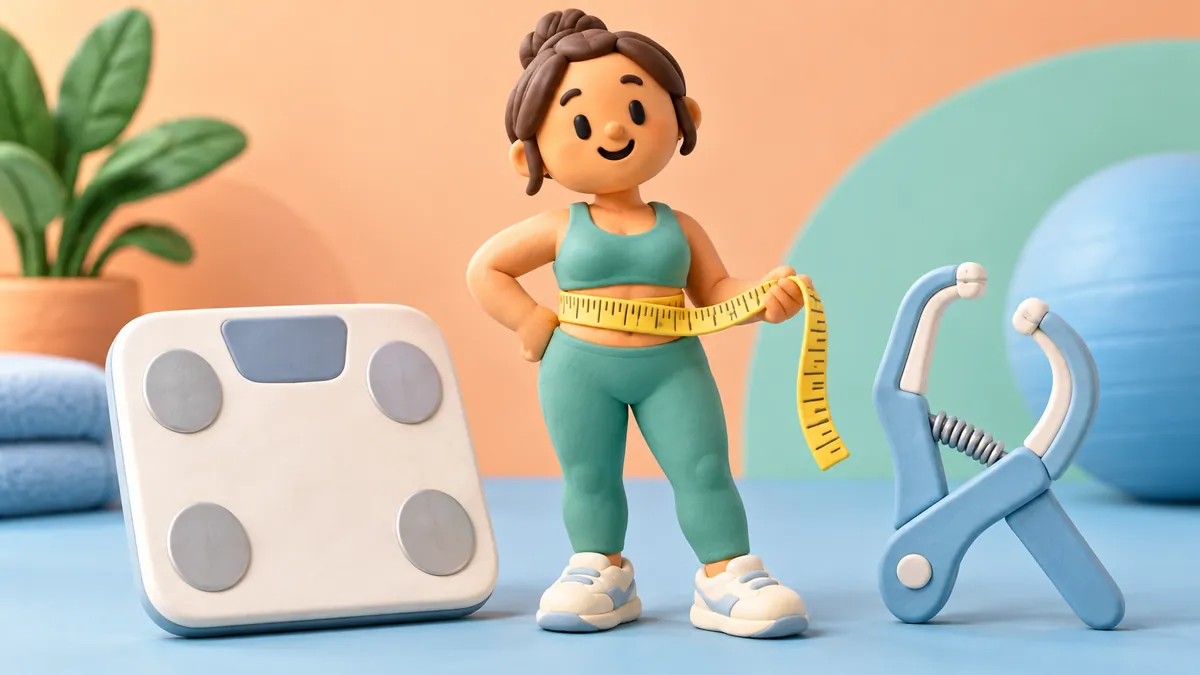
Body fat percentage tells you what your weight is made of — and unlike a scale, it doesn't lie when you're building muscle and losing fat at the same time. This tutorial walks through the practical ways to measure it at home, what each method costs in accuracy, and how to track changes that mean something.
Quick Answer
Five methods, ranked by accuracy and cost:
| Method | Accuracy | Cost | Effort | |---|---|---|---| | DEXA scan | ±1–2% | $$$ | Clinic visit | | Hydrostatic / Bod Pod | ±1–3% | $$ | Clinic visit | | Skinfold calipers | ±3–5% | Low | Skill needed | | U.S. Navy tape | ±3–4% | Free | DIY, consistent | | BIA (smart scale) | ±5–8% | Low–med | Daily, sensitive |
Most home users get the best ratio with the U.S. Navy tape method — free, repeatable, and reasonably accurate. Run yours via our Body Fat Calculator.
The U.S. Navy Tape Method
A flexible tape measure and consistency. That's the whole kit.
What You Need
- Flexible (cloth or vinyl) tape measure
- A friend (optional but helpful for the neck measurement)
- Notebook or app to record
Where to Measure
- Neck — narrowest point, just below the larynx, looking straight ahead
- Waist (men) — at the navel, relaxed, not holding breath
- Waist (women) — at the narrowest point of the torso
- Hip (women only) — widest point around the buttocks
Take each measurement three times, average them. Tape should be snug, not tight, not loose.
The Formula
Inches in, percent body fat out:
- Men: %BF = 86.010 × log₁₀(waist − neck) − 70.041 × log₁₀(height) + 36.76
- Women: %BF = 163.205 × log₁₀(waist + hip − neck) − 97.684 × log₁₀(height) − 78.387
Our calculator computes this — and converts cm if you measure in metric.
Step-by-Step Walkthrough
For a 178 cm (70.1 in) man:
- Neck = 38 cm (15 in)
- Waist = 85 cm (33.5 in)
- waist − neck = 18.5 in
- log₁₀(18.5) ≈ 1.267
- log₁₀(70.1) ≈ 1.846
- %BF = 86.010 × 1.267 − 70.041 × 1.846 + 36.76 ≈ 17.4%
In the Fitness category for adult men.
Lean Body Mass and Fat Mass
Once you have %BF, the most useful derived numbers are:
- Lean Body Mass (LBM) = weight × (1 − %BF/100)
- Fat Mass (FM) = weight × (%BF/100)
For the man above at 75 kg: LBM = 75 × 0.826 ≈ 62 kg, FM ≈ 13 kg. Track these to see whether weight changes are coming from fat or muscle.
Skinfold Calipers
Skinfolds estimate body fat by measuring subcutaneous fat at standardised sites. Multi-site protocols (Jackson-Pollock 3-site or 7-site) are more accurate than single-site.
Pros: cheap, fast, established.
Cons: technique matters a lot. Same person, same day, different testers can differ by 3–5%. Use the same tester, same time of day, same conditions.
BIA (Smart Scales and Hand-Held Devices)
Bio-electrical impedance sends a tiny current through the body and infers composition from resistance. Hydration changes resistance significantly, so:
- Always measure same time of day (morning works best)
- Same hydration state (after using the bathroom, before drinking)
- Same conditions (food, exercise hours-prior consistent)
Accuracy is roughly ±5–8%. Use BIA for trend, not absolute number.
DEXA / Hydrostatic / Bod Pod
The lab-grade methods.
- DEXA is widely considered the practical gold standard (~±1–2%). Bonus: also gives bone density and visceral-fat estimates.
- Hydrostatic weighing (underwater): very accurate, less available.
- Bod Pod (air displacement): comparable accuracy, comfortable.
Most people use a lab test once or twice a year as a calibration anchor against their cheaper home method.
Tracking Changes That Matter
A few rules to spot real change vs noise:
- Same method, same conditions, every time.
- Monthly cadence for tape or BIA; weekly is too noisy.
- 3-point change in %BF is the threshold most home methods can detect reliably.
- Pair with tape measurements (waist, hip, chest) — fat loss usually shows there first.
If three of (BMI, body fat %, waist tape, photos) move in the right direction, the change is real.
Body Fat Categories — What the Number Means
Once you have a measurement, what to do with it depends on where it sits. Approximate categories for adult populations:
Men:
| %BF | Category | What it usually looks like | |---|---|---| | 2–5% | Essential fat | Stage bodybuilders, day of show — not sustainable | | 6–13% | Athletic | Visible abs, full vascularity, sharp muscle separation | | 14–17% | Fitness | Mild ab outline, healthy and athletic appearance | | 18–24% | Average | Soft, no ab definition, healthy range | | 25%+ | High | Visible roundness, elevated metabolic risk above ~28% |
Women:
| %BF | Category | What it usually looks like | |---|---|---| | 10–13% | Essential fat | Hormonal disruption likely below this | | 14–20% | Athletic | Lean and muscular; minimum sustainable for most | | 21–24% | Fitness | Toned, healthy, energetic appearance | | 25–31% | Average | Soft, healthy range for most women | | 32%+ | High | Elevated metabolic risk above ~38% |
The sustainable healthy range is typically 12–20% for men and 18–28% for women. The athletic ranges are reachable but cost adherence, and pushing below them long-term carries hormonal cost.
Picking a Target
A pragmatic body-fat target is the one you can hold without misery. Three categories of goal:
- General health: aim for 15–20% (men) or 22–28% (women). Health markers, energy and life balance all favour this band.
- Visible muscle and "good photo year-round": 10–14% (men) or 18–22% (women). Achievable, requires consistent training and tracking, but does not demand contest-level discipline.
- Stage / competition / fitness-shoot lean: 5–8% (men) or 14–18% (women). Time-limited, not a way of life. Plan to return to a sustainable level after the event.
The bigger the gap between current and target, the longer the timeline. Going from 22% to 12% is usually a 6–12 month project, not a 6-week one.
Common Mistakes
- Trusting one smart-scale reading. Use the weekly average.
- Measuring after a workout or hot shower. Hydration shifts results.
- Inconsistent tape placement. Mark the spots if needed.
- Switching methods mid-cut. Stay with one for the duration.
- Aiming for "essential" body fat as a target. Essential is the physiological minimum (2–5% men, 10–13% women), not a healthy steady state.
Frequently Asked Questions
Which home method is most accurate?
The U.S. Navy tape method, used consistently. Skinfolds are slightly more accurate if you have a skilled tester; otherwise tape wins on repeatability.
Can I trust my smart scale?
For trend, yes. For absolute number, expect ±5–8% error. Most people see daily BIA swings of 2–3% from hydration alone.
How often should I measure?
Monthly is enough for tape and DEXA. Weekly for BIA if you average values. Daily is overkill and creates anxiety.
Why don't doctors use body fat %?
Time and equipment. BMI takes 30 seconds; body fat needs either training (calipers, tape) or a machine. BMI screens populations; body fat % diagnoses individuals.
Are home tests good enough?
Yes — for tracking change over months. Absolute number matters less than direction and rate of change for almost every fitness goal.
Bottom Line
You don't need a clinic to measure body fat — you need consistency.
- Pick a method that fits your budget and discipline.
- Use the same method, same conditions, every time.
- Run the math via our Body Fat Calculator.
- Pair with our BMI Calculator for the broader health context.
- Track monthly, expect a 3-point change before declaring victory.
The cheapest method you stick with beats the most accurate method you don't.
Health and fitness calculations are estimates only and not medical advice. If body fat % deviates significantly from your perceived health status, consult a healthcare provider for a proper assessment.