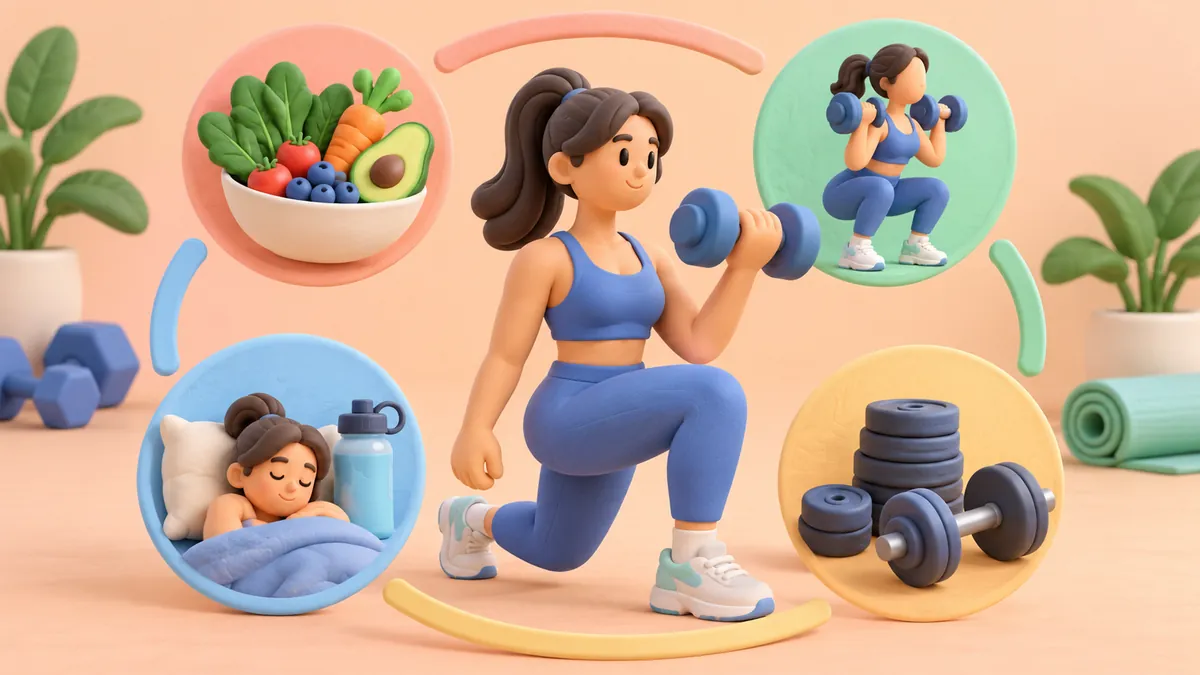
Most "women-specific" training advice is recycled magazine copy: light dumbbells, high reps, and a vague warning about "getting bulky." The actual research tells a different story. Women respond to strength training with the same mechanisms as men, recover well from heavy work, and often tolerate more weekly volume than male peers. The real programming questions are about absolute loads, recovery rhythm, and fueling around the menstrual cycle — not about avoiding barbells.
Quick Answer
| Variable | What the evidence supports | |---|---| | Sex differences in response | small; same exercises, same progression model | | Absolute load | lower than male peers; relative strength per kg of bodyweight is comparable in squat and deadlift | | Weekly volume tolerance | often slightly higher than male peers; faster recovery | | Rep range | full spectrum, including heavy sets at 85 percent of 1RM or above | | Menstrual cycle | worth tracking for context, not a reliable driver of week-to-week programming | | Protein floor | 1.6 to 2.2 g per kg bodyweight per day | | Luteal phase fueling | many women need 200 to 300 extra kcal per day | | Pregnancy and postpartum | individualized; work with your provider |
Bottom line: train hard, lift heavy across the full rep range, eat enough protein, and let the menstrual cycle inform recovery and fueling without micromanaging your program around it. Progressive overload is still the main lever.
What the Science Shows About Women and Strength
Men and women share the same skeletal muscle physiology — fiber types, hypertrophy signaling, response to mechanical tension. When you control for training experience and relative load, the percent gain in strength and lean mass is similar between the sexes.
Where the differences do show up:
- Absolute strength is lower in women on average, mostly because of muscle cross-sectional area and lever arms.
- Relative strength per kilogram of bodyweight is much closer than people assume. Trained women squat and deadlift bodyweight ratios that match or exceed lightly trained men.
- Fatigue resistance tends to be higher — more reps at a given percentage of 1RM and faster recovery between sets, especially on lower-body work.
- Recovery between sessions is generally faster, particularly in the follicular phase.
The basic prescription is unchanged: lift progressively heavier weight, eat enough, sleep enough. Our 1RM calculator estimates a max from any working set in the 3 to 10 rep range, and the calculating your 1RM guide walks through testing options.
The Menstrual Cycle and Training Quality
The menstrual cycle gets a lot of attention in women's training content, but the evidence on programming changes based on cycle phase is much weaker than social media suggests.
A simplified picture:
- Follicular phase (day 1 through ovulation, around day 14). Estrogen rises. Many women feel strong and able to push hard sessions.
- Luteal phase (day 15 to day 28). Progesterone rises. Resting body temperature climbs by about 0.3 to 0.5 degrees Celsius. Many women report higher perceived effort and worse sleep, especially late luteal.
- Menstruation (day 1 of the next cycle). Some women feel fine; others feel depleted and prefer lighter days.
What the research does not strongly support: systematically programming heavier loads in the follicular phase and lighter in luteal, "cycle-synced" programs outperforming standard templates, or skipping training during your period.
What it does support: tracking your cycle for context so a hard late-luteal session is interpreted correctly; paying more attention to hydration and electrolytes in the luteal phase; planning for worse sleep late luteal; and pre-deciding a minimum-viable session for low-motivation days.
The honest summary: track to understand yourself, not to optimize your program. Progressive overload, sufficient protein, and consistent training are still doing 90 percent of the work.
| Phase | Subjective feel | Programming note | |---|---|---| | Early follicular (day 1-7) | variable | train as planned; reduce volume only if symptoms are heavy | | Late follicular (day 8-14) | often highest energy | good window for PR attempts or hard top sets | | Ovulatory (around day 14) | strong | no specific change needed | | Early luteal (day 15-21) | usually normal | train as planned | | Late luteal (day 22-28) | higher perceived effort, possible bloating | keep training; expect RPE to climb; add 200-300 kcal if appetite rises |
Volume: Why Many Women Can Handle More
When matched for relative load, women often perform more total reps and recover faster between sets than men. Likely reasons include fiber-type distribution, better capillary density, and lower absolute force per contraction, which means less local fatigue per rep.
The implication is that per-session and weekly set volume can be slightly higher for many women without overreaching. A trained female lifter doing 18 to 22 hard sets per week per major muscle group is often still in the productive range, where her male partner at the same relative loads might benefit from staying closer to 12 to 16.
A reasonable starting framework:
- Beginner: 8 to 12 hard sets per muscle group per week
- Intermediate: 12 to 18 hard sets per muscle group per week
- Advanced: 16 to 22 hard sets per muscle group per week
Hard sets means sets taken within 2 to 3 reps of failure, not warm-ups. The how to increase your 1RM safely guide walks through periodization basics that scale up cleanly as volume tolerance grows.
Intensity: Heavy Sets Belong in Women's Programs
A persistent gap in women's training advice is the assumption that the right rep range is 12 to 20. It isn't — or at least, it isn't the only one.
Heavy sets in the 1 to 5 rep range at 85 percent of 1RM or above build maximal strength, recruit high-threshold motor units, and improve neural drive. These adaptations apply to women the same way they apply to men, and skipping them leaves strength and bone-density benefits on the table.
A balanced female strength program typically includes:
- Heavy compound work (1 to 5 reps at 85 percent of 1RM or above) for squat, deadlift, press, row — once per week per pattern
- Moderate hypertrophy work (6 to 12 reps at 70 to 85 percent of 1RM) as the bulk of weekly volume
- Higher-rep accessory work (12 to 20 reps) for smaller muscle groups and joint health
Women who avoid heavy sets out of fear of "getting bulky" are protecting against a problem that doesn't exist. Significant hypertrophy in women requires years of consistent heavy training and a substantial caloric surplus.
Protein, Calories, and Luteal-Phase Fueling
Protein needs scale with bodyweight, not with sex. The evidence-supported range for active women is 1.6 to 2.2 grams per kilogram of bodyweight per day. For a 65 kg (143 lb) woman, that's 104 to 143 grams per day; for a 75 kg (165 lb) woman, 120 to 165 grams.
A lot of women undereat protein because they undereat in general. If you're training hard four or five days per week and consuming 60 to 80 grams of protein, you will not see the muscle response you'd expect from the work in the gym. Run your numbers through our macro calculator and audit your actual intake for a week.
Luteal-phase calorie needs. Resting metabolic rate rises by roughly 2 to 8 percent during the luteal phase — about 100 to 300 extra kcal per day. Appetite often increases noticeably, and white-knuckling through luteal hunger on the same calorie target as your follicular days is a common reason cutting phases stall.
In a maintenance or surplus phase, eat to satiety and let luteal-phase hunger pull a couple hundred extra kcal in, mostly from protein and starchy carbs. In a deficit, set your luteal-week target 150 to 250 kcal higher than your follicular-week target. Track weekly averages — a 2 to 4 lb swing at the end of the luteal phase is water, not fat.
The macronutrients explained guide covers the fundamentals, and the macro calculator gives you a starting point you can adjust by cycle phase.
Relative Strength and the Bodyweight Ratio
A useful exercise for any woman who has been told she "can't" lift heavy is to look at bodyweight ratios.
| Lift | Untrained | Trained | Advanced | |---|---|---|---| | Squat | 0.5x | 1.25x | 1.75x | | Deadlift | 0.75x | 1.5x | 2.0x | | Bench press | 0.4x | 0.8x | 1.1x | | Overhead press | 0.3x | 0.55x | 0.8x |
Trained male numbers in squat and deadlift cluster around 1.5x to 2.0x bodyweight at similar training ages. Women close that gap on lower-body lifts more than on upper-body lifts. Use these as orientation, not targets — the 1RM calculator lets you check where your top sets land relative to your bodyweight.
Pregnancy and Postpartum: A Brief Note
Pregnancy, postpartum recovery, and perimenopause each involve enough individual variation and medical context that no general article should be prescriptive. The high-level points most providers agree on:
- In an uncomplicated pregnancy, continuing to strength train at modified intensity is generally encouraged. ACOG supports continued exercise for most pregnancies.
- Postpartum return to lifting is individualized. Pelvic floor health, diastasis recti recovery, and energy availability all matter. Working with a pelvic floor physical therapist before returning to heavy loading is a strong default.
- Perimenopause brings changes in recovery, body composition, and bone density that respond well to maintained strength training — often more strength work, not less.
In any of these phases, the people who should drive your programming are your healthcare provider and a coach experienced with women in your situation.
Common Misconceptions
- "Lifting heavy will make me bulky." It will not. The hormonal environment required for the hypertrophy women fear is one most women do not naturally have. Physique-sport athletes who reach that look train for many years with intentional surplus calories.
- "I should just do cardio to lose weight." A mostly-cardio program in a deficit tends to lose muscle along with fat, lowering maintenance calories and making the next phase harder. At least 3 strength sessions per week preserves lean mass during a cut. See the body recomposition guide.
- "Higher reps are safer for women." No. Form, load selection, and progression determine safety. A well-coached 3-rep set at 85 percent is safer than a sloppy 15-rep set at 65 percent.
- "My cycle ruins my training." Some late-luteal sessions will feel harder. That is information, not catastrophe. Show up, do the minimum-viable session, and trust the week-over-week trend.
Frequently Asked Questions
Will heavy lifting make me look bulky?
No, not in any way that happens accidentally. The combination of long training history, surplus calories, and individual genetics that produces a visibly large female physique is rare and intentional. Recreational lifting on a typical eating pattern produces a leaner, stronger, more athletic look. Women who add heavy strength work often report looking smaller in clothes because lean mass is denser than fat.
Should I change my program based on my menstrual cycle?
The evidence for systematic phase-based programming is weaker than social media suggests. Track your cycle for context — so a hard late-luteal session is interpreted correctly — but keep your weekly programming consistent. The main lever for progress is still progressive overload across weeks and months.
How much protein do I actually need?
1.6 to 2.2 grams per kilogram of bodyweight per day covers the evidence for women training for strength or recomposition. For a 60 kg (132 lb) woman, that's 96 to 132 grams per day. Many women undershoot this significantly. Use the macro calculator to set a target and audit your actual intake for a week.
Can I train during my period?
For most women, yes. Some feel low on day 1 and train lighter or skip; others feel completely normal. There is no medical reason to avoid training during menstruation in an otherwise healthy cycle. Hydrate well and let perceived effort guide whether it's a hard day or a maintenance day.
Do I need to lift heavy, or can I just use light weights and high reps?
You can build meaningful muscle in the 8 to 20 rep range if you take sets close to failure. But you will leave maximal strength, neural adaptation, and some bone-density benefit on the table if you never train above 80 percent of 1RM. A balanced program includes some work in the 1 to 5 rep range each week. The protein intake guide covers the fueling side; without it, heavy training underperforms.
Why do I gain weight before my period?
Two things are usually combined. Glycogen and water storage after a hard training week can add 2 to 4 lb unrelated to fat. Luteal-phase fluid retention adds another 1 to 4 lb in the days before menstruation. Track weight as a 7-day rolling average and ignore single-day spikes — see the body fat calculator if you want a more stable composition measure than scale weight alone.
Health and fitness information here is for general education and is not medical advice. Pregnancy, postpartum, perimenopause, and any underlying condition warrants a conversation with your healthcare provider before changing training.